What Happens If the Wrong Score Is Called in Pickleball? Replay, Fault or Play On
The rulingStop before the return, replay
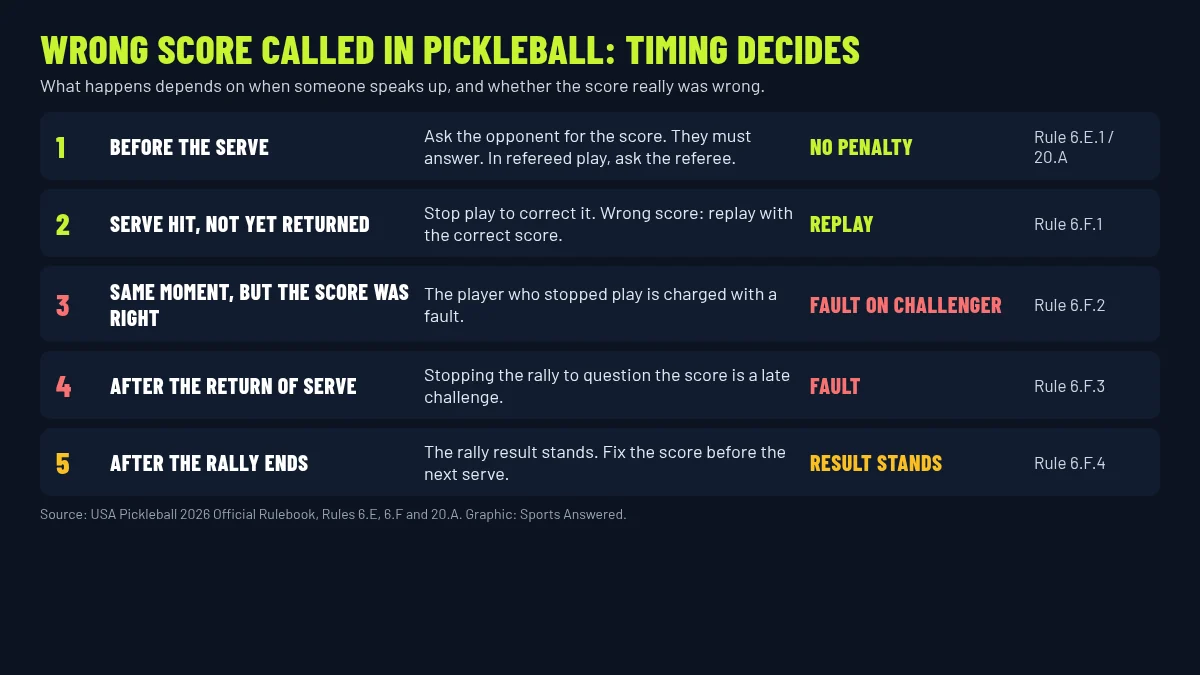
If the wrong score is called in pickleball, what happens depends on when someone stops play. Stop the rally before the return of serve is hit and it is replayed with the correct score. Stop it after the return and it is a fault against you. If nobody stops it, the rally counts as played and the score is fixed before the next serve. All of this is Rule 6.F in the USA Pickleball 2026 Official Rulebook.
| When the wrong score is noticed | What happens | Rule |
|---|---|---|
| Before the serve | Ask your opponent for the score; they must answer | 6.E.1 |
| After the serve, before the return of serve is hit | Stop play: the rally is replayed with the correct score | 6.F.1 |
| You stop play, but the score called was correct | Fault against the player who stopped play | 6.F.2 |
| After the return of serve is hit | Stopping now is a late challenge: fault against the player who stopped play | 6.F.3 |
| After the rally is over | The result stands; correct the score before the next serve | 6.F.4 |
Calling the wrong score is not a fault
The rulebook does not penalize the server for getting the numbers wrong. What it penalizes is how the other players react. The server normally calls the score once all players are, or should be, in position and ready (Rule 6.B), and must finish the whole call before serving: hitting the serve while the score is still being called is a fault (Rule 6.C.1).
The format of the call matters, because a call with a number missing is also a wrong call:
- Singles: two numbers, server's score then receiver's score, starting "zero, zero" (Rule 6.B.1).
- Doubles: three numbers, serving team's score, receiving team's score, then the server number, starting "zero, zero, two" (Rule 6.B.2). If the server cannot call the score, the partner may, and the same player calls it for the whole game (Rule 6.B.2.a).
The safest move: ask before the serve
Rule 6.E.1 lets any player ask an opponent for the correct score before the serve is hit, and the opponent must respond. That costs nothing. Once the serve is in the air you are into Rule 6.F, and the timing starts to count against you.
In a refereed match, the referee calls the score (Rule 17.D.2), and Rule 20.A lets any player ask the referee for the score before the serve.
The replay window is short
Rule 6.F allows a player to stop a rally for a score correction "before the return of serve is hit and before the ball becomes dead." Inside that window, if the score was wrong, the rally is replayed with the correct score (6.F.1). Outside it, stopping play is a late challenge and a fault (6.F.3).
That is the one exception to the general rule on stopping play. Rule 9.A.1 says stopping a rally is a fault, apart from a few listed cases, and a correct score challenge under 6.F.1 is one of them.
A worked doubles example
Say the serving team has 5 points, the receivers have 3, and it is the first server. The correct call is "5, 3, 1." The server calls "5, 4, 1" and serves.
- The receiver stops play before hitting the return. The score was wrong, so the rally is replayed after the server calls "5, 3, 1" (6.F.1).
- The receiver returns the serve, then stops play. That is a late challenge and a fault on the receiving team (6.F.3). The serving team wins the rally.
- Nobody stops play and the serving team wins the rally. The rally stands, so the serving team goes to 6, and the score is corrected before the next serve: "6, 3, 1" (6.F.4).
- The receiver stops play before the return, but "5, 4, 1" turns out to be right. Fault on the receiving team, the player who challenged a correct call (6.F.2).
"Replay any rally played on a wrong score" is wrong
Some guides and glossaries say a rally played after a wrong score call does not count and must be replayed. Under the 2026 rulebook that is not the case. Rule 6.F.4 is plain: when an incorrect score was called and the rally is completed, the result stands and the score is corrected before the next serve. Older guides may also cite rule numbers from earlier editions of the rulebook, so check the current one.
Rebuilding the score when nobody agrees
Player positions can help you work out the right score, because the rulebook ties them to it:
- Singles: the server serves from the right side when their score is zero or even and from the left when it is odd (Rule 5.A.1).
- Doubles: for each team, the player who started the game serving belongs on the right side when the team's score is zero or even and on the left when it is odd, with the partner opposite (Rule 5.B.3). This applies whether that team is serving or receiving.
So if your team's starting server is on the left, your team's score should be odd. For more on doubles order, see our guides on who serves in pickleball and where to stand when receiving a pickleball serve. Singles players can check how to score pickleball singles.
Players who are on the wrong side are covered by a separate rule. Under Rule 5.C.2, if the correct server or receiver was out of position when the score was called and the rally is completed, the result also stands.
The easiest fix is not to lose track in the first place. Our free pickleball score keeper tracks both scores and the server number for you, point by point.
Quick questions
- Is it a fault if the server calls the wrong score in pickleball?
No. Calling the wrong score is not a fault on its own. If an opponent stops play before the return of serve, the rally is replayed with the correct score (USA Pickleball Rule 6.F.1).
- Can you stop play after the return of serve to fix the score?
Not without a penalty. Stopping a rally to ask for a score correction after the return of serve is a late challenge and a fault against the player who stopped play (Rule 6.F.3).
- What if nobody notices the wrong score until the rally is over?
The result of the rally stands, and the score must be corrected before the next serve (Rule 6.F.4). The rally is not replayed.
- What if I stop play and the score was actually right?
Then it is a fault against you, the player who stopped the rally (Rule 6.F.2).
- Can I ask my opponent for the score?
Yes. Before the serve is hit, you may ask your opponent for the correct score and they must answer (Rule 6.E.1). In a refereed match you ask the referee (Rule 20.A).
Rulebook sources
- USA Pickleball 2026 Official Rulebook (Rules 5.A, 5.B, 6.B to 6.F, 9.A, 17.D, 20.A), USA Pickleballusapickleball.org
Rule statements were checked against these sources on October 31, 2026. See a mistake? Read our corrections policy or email contact@sportsanswered.com.
Who answered
Sports Answered Editorial Team. Researched against the official rules, written and fact-checked by our editors. How we answer
Expert review
Reviewed by Bob Savar on October 31, 2026.