What Happens If You Hit the Wrong Ball in Golf? Penalty and Fix
The ruling2 strokes (stroke play) or loss of hole (match play)
Two penalty strokes in stroke play. Loss of the hole in match play. Those are the penalties for making a stroke at a wrong ball under Rule 6.3c of the Rules of Golf (The R&A and USGA, Rule 6).
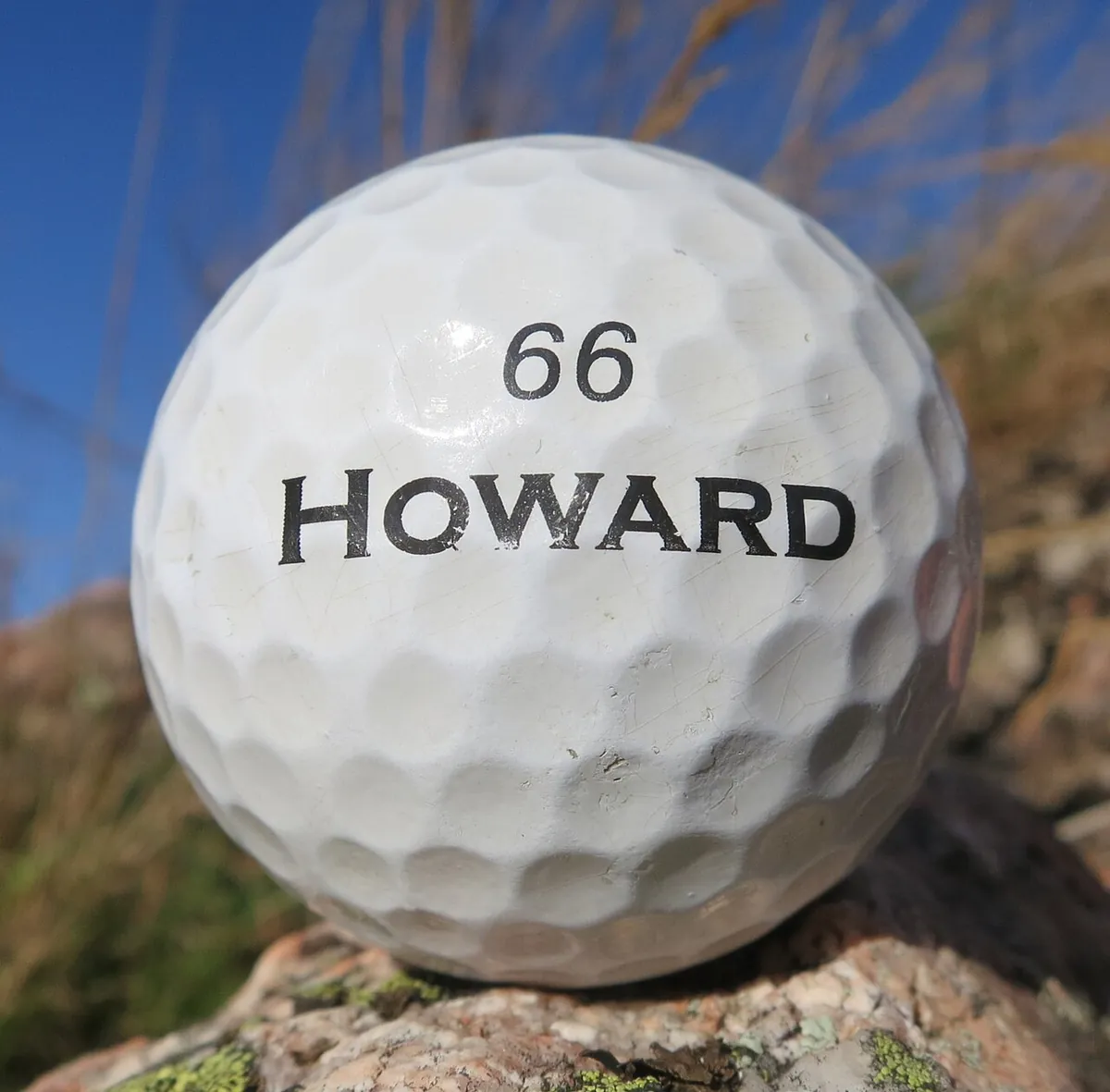
In stroke play the penalty is only half the job. The shot you hit with the wrong ball does not count, and you must go back and finish the hole with your own ball. If you skip that step and tee off on the next hole, you are disqualified.
What counts as a "wrong ball"
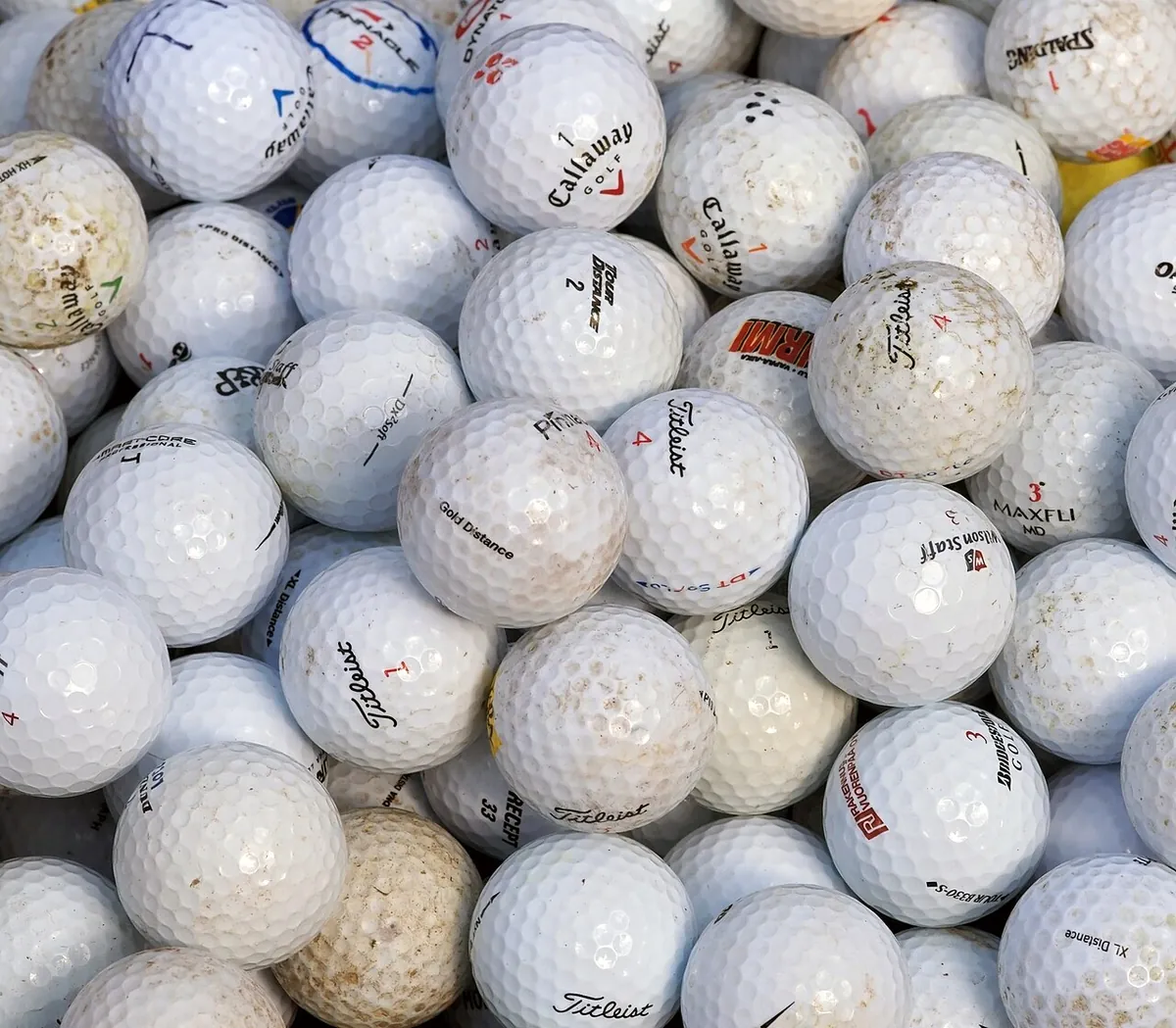
The Rules define a wrong ball as any ball other than your ball in play, your provisional ball (until it has to be abandoned), or a second ball you are allowed to play in stroke play under Rule 14.7b or 20.1c (Rules of Golf, Definitions). The definition gives these examples:
- another player's ball in play,
- a stray ball someone left on the course, and
- your own ball that is out of bounds, has become lost, or has been lifted and not yet put back in play.
That last group surprises people. If you hit your drive out of bounds, put another ball in play and then find the first ball and hit it, you have played a wrong ball, even though it has your mark on it.
Stroke play: penalty, then correction
Here is what Rule 6.3c(1) requires once you discover the mistake:
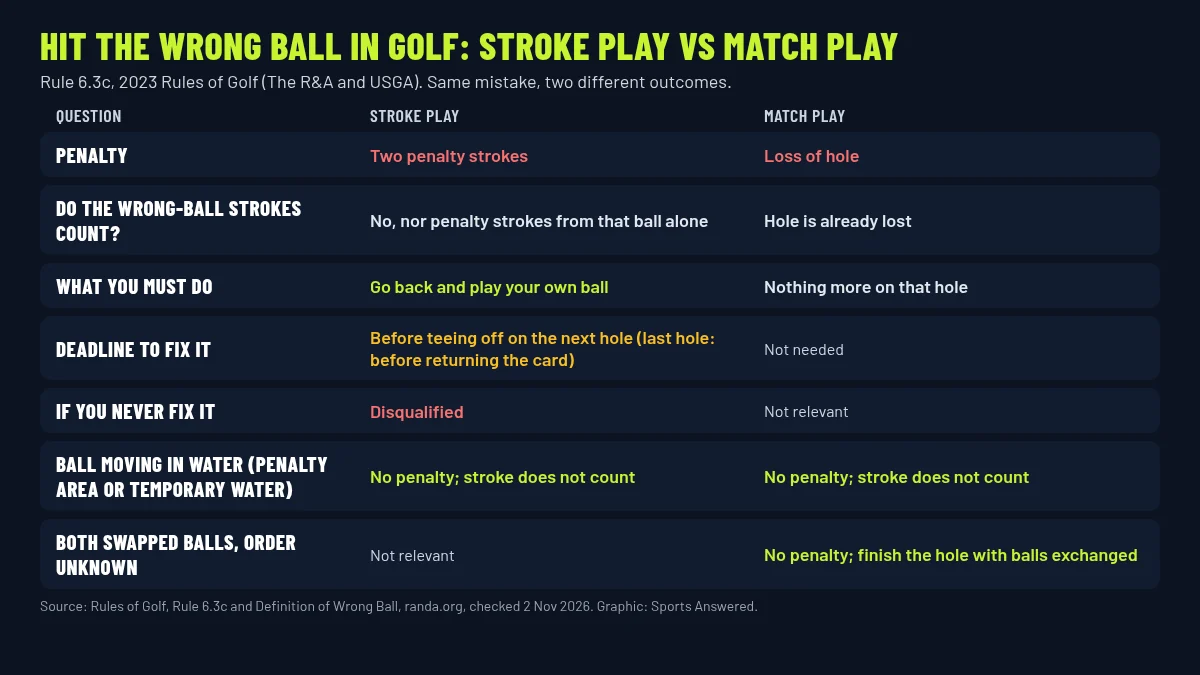
- Add two penalty strokes. This is the general penalty in stroke play.
- Strike out the wrong-ball strokes. The stroke at the wrong ball and any more strokes before you correct the mistake do not count. Penalty strokes that came only from playing that ball (say, you took an unplayable with it) do not count either.
- Go back to your own ball. Play it as it lies, or take relief if a Rule allows it. If your ball cannot be found, normal lost-ball rules apply; see our guide to the lost ball rule in golf.
- Beat the deadline. You must correct the mistake before making a stroke to begin another hole. On the final hole, the deadline is returning your scorecard. Miss it and you are disqualified.
A worked example: you hit your tee shot (1) into the rough, then hit a ball you find there (a stray ball) twice before noticing the brand is wrong. Those two swings do not count. You add two penalty strokes, find your own ball, and your next stroke with it is your 4th.
Match play: the hole is gone
In match play the general penalty is loss of the hole, so there is no need to correct anything on that hole.
One special case: if you and your opponent play each other's balls on the same hole, the first player to make a stroke at a wrong ball loses the hole. If nobody can tell who hit first, there is no penalty and you play the hole out with the balls exchanged.
The one no-penalty exception: a ball moving in water
If you make a stroke at a wrong ball that is moving in water in a penalty area or in temporary water, there is no penalty. The stroke does not count, and you correct the mistake by playing the right ball from its original spot or by taking relief under the Rules (Rule 6.3c(1), Exception). This exists because you cannot sensibly identify a ball drifting in a stream.
There is no similar exception for bunkers or penalty areas in general. A wrong ball played from sand or from a dry ditch is penalized like any other.
If someone else played your ball
You are the victim here, not the offender. If it is known or virtually certain that another player played your ball as a wrong ball, you put your original ball or another ball on the original spot, estimating the spot if you do not know it, and play on with no penalty (Rule 6.3c(2)). This applies whether or not your original ball has been found.
When your provisional becomes a wrong ball
A provisional ball is not a wrong ball while it is allowed. It must be abandoned if your original ball is found on the course outside a penalty area within the three-minute search, or is found or known to be in a penalty area. From then on the provisional is a wrong ball, you must not hit it again, and any strokes you already made with it do not count (Rules of Golf, Rule 18.3c).
How to avoid it: mark it, identify it
Rule 6.3a says every player should put an identifying mark on the ball they play. Rule 7.2 then lists the ways a ball counts as identified (Rules of Golf, Rule 7):
| How you identify it | Catch |
|---|---|
| Someone saw it come to rest where it is known to be your ball | None |
| You see your own identifying mark | Does not work if an identical ball with an identical mark is in the same area |
| Same brand, model, number and condition, where your ball is expected | Does not work if an identical ball is nearby and you cannot tell which is yours |
If you cannot identify a ball as it lies, you may lift it to check (Rule 7.3). Mark the spot first, do not clean it more than needed to identify it, and replace it on the same spot. Skipping the mark, lifting when it was not reasonably necessary, or cleaning when not allowed costs one penalty stroke.
A brand and number alone are weak protection, because playing partners often use the same ball model. A few dots or a line in your own pattern settles it.
Related rulings
If your ball strikes another ball on the putting green instead, see what happens when your golf ball hits another ball on the green.
These rulings come from the 2023 Rules of Golf, published jointly by The R&A and the USGA, which the R&A site shows as current when we checked on 2 November 2026.
Quick questions
- Do the strokes I hit with the wrong ball count on my score?
No. In stroke play, the stroke at the wrong ball and any further strokes with it before you correct the mistake are not counted, including penalty strokes that came only from playing that ball. You add the two-stroke penalty instead.
- Someone else played my ball. Am I penalized?
No. You place your original ball or another ball on the spot where your ball was, estimating the spot if you don't know it, and carry on (Rule 6.3c(2)). The penalty belongs to the player who hit the wrong ball.
- Is hitting a provisional ball the same as hitting a wrong ball?
Not while the provisional is allowed. It becomes a wrong ball only once it has to be abandoned, for example when your original ball is found on the course outside a penalty area within the three-minute search (Rule 18.3c(3)).
- What if I only realize on the next tee?
In stroke play, you can still go back and correct it as long as you have not made a stroke to start the next hole. Once you tee off on the next hole without correcting it, you are disqualified. On the last hole, the deadline is returning your scorecard.
- Is there a penalty for hitting the wrong ball out of a bunker?
Yes. Rule 6.3c makes no exception for bunkers. The only no-penalty case is a wrong ball that is moving in water in a penalty area or in temporary water.
Rulebook sources
- Rules of Golf, Rule 6 (Playing a Hole), Rules 6.3a to 6.3c, The R&A and USGAranda.org
- Rules of Golf, Definitions (Wrong Ball; Ball in Play; General Penalty), The R&A and USGAranda.org
- Rules of Golf, Rule 7 (Ball Search: Finding and Identifying Ball), The R&A and USGAranda.org
- Rules of Golf, Rule 18 (Stroke-and-Distance Relief, Ball Lost or Out of Bounds, Provisional Ball), The R&A and USGAranda.org
Rule statements were checked against these sources on November 2, 2026. See a mistake? Read our corrections policy or email contact@sportsanswered.com.
Who answered
Sports Answered Editorial Team. Researched against the official rules, written and fact-checked by our editors. How we answer
Expert review
Pending. A certified coach or official will review this ruling; their name will appear here only after they approve it.