Is It Better to Serve First in Pickleball? What to Pick When You Win the Toss
The rulingSlight edge, only with your best server first
Usually, yes, but the edge is smaller than the coin toss drama suggests, and it depends on two things most players never think about: who serves for your team first and which end of the court you start on. When the teams are even and the game goes to 11, serving first is close to a coin flip. When your team has one clearly stronger server and that player starts, serving first is the better pick.
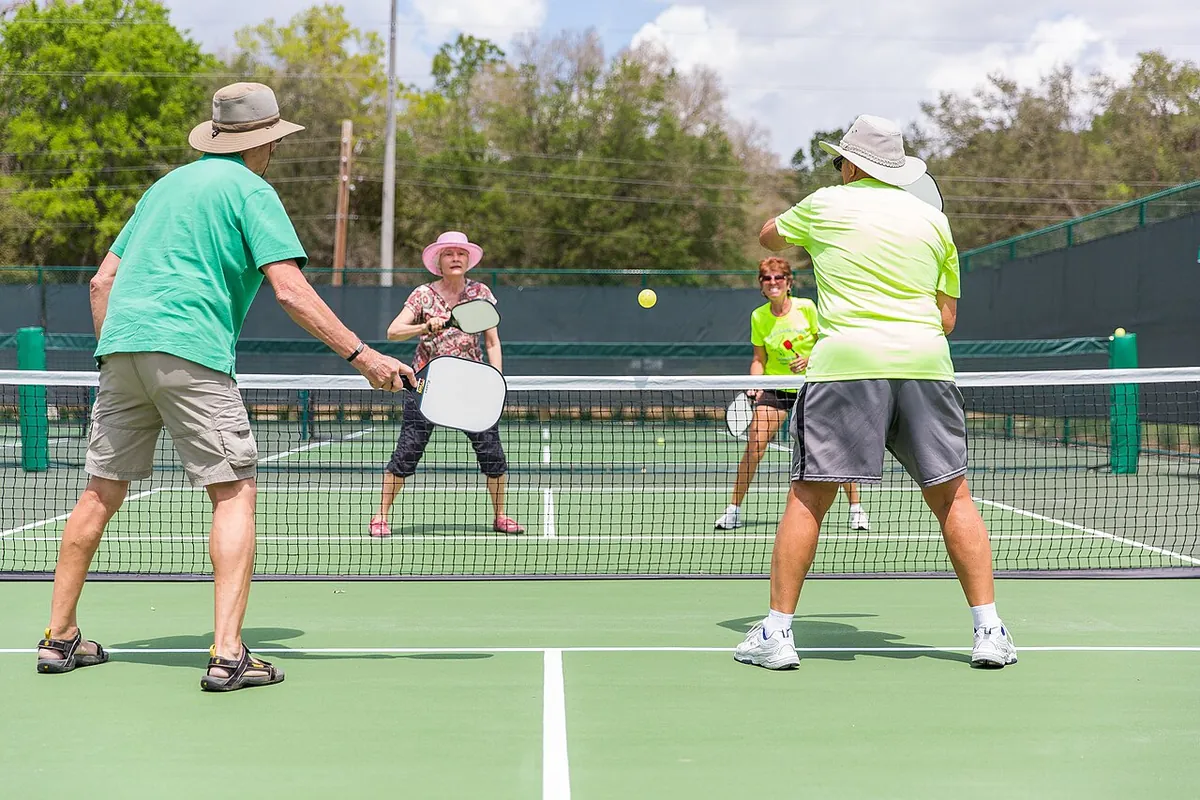
The reason the edge is small sits in the rulebook. In standard doubles, the team that serves first gets only one server in its first turn, which is why the score opens at 0-0-2 (USA Pickleball Official Rulebook, Rule 5.B). The receiving team then gets both partners serving. You trade a head start for a short turn.
What the toss winner actually gets to choose
Most players think the toss is serve or receive. It is a four-way choice. In refereed play, the referee uses a fair method, such as a coin toss or picking a number written on the back of the scoresheet, and the winner may choose to serve, choose to receive, choose the starting end, or defer the first choice to the opponent. Once a selection is made it cannot be changed (Rule 17.C.4).
The side that does not win the toss takes whatever is left. If you pick the end, your opponent picks serve or receive. That matters on windy or sunny days, as you will see below.
In casual games nobody enforces a method. Paddle spins and "pick a number" both work, as long as everyone agrees before the first serve.
Why serving first is not a free point
Three rules shape the trade-off.
| Rule | What it says | What it means at the toss |
|---|---|---|
| 4.A | In standard scoring, only the serving side scores | The first team to serve gets the first chance to put up a point |
| 5.B, 5.B.2 | At the start of each game only the starting server serves before the side out; that player counts as the second server | The first serving team gets one server, the other team gets two |
| 5.A.2 | In singles, the server keeps serving until losing a rally | No short opening turn in singles |
| 14.A.2, 14.A.5 | Rally scoring: every rally scores, one server per team turn | No 0-0-2 opening; serving first matters less |
| 21.B.1 to 21.B.3 | Ends change at 6 (game to 11), 8 (to 15) or 11 (to 21), in single-game matches and tie-breaker games | The end you start on is not the end you finish on |
Put simply, the first team to serve can only score until one player loses one rally. If that player is your weakest server, your head start can be gone after one point or none. The full rotation, with a rally-by-rally example, is in our guide to who serves in pickleball and in what order.
What a 10,000-game simulation found
No governing body publishes win rates for teams that serve first, and we have not found match data large enough to settle it. The closest thing is a computer model published by the Mathematical Association of America in August 2024. Engineer William Figary and Elizabethtown Community and Technical College math instructor Miky Wright simulated 10,000 games for each of several scenarios, in games to 11 and to 15 with end changes at 6 and 8 (MAA Math Values).
Their findings, in plain terms:
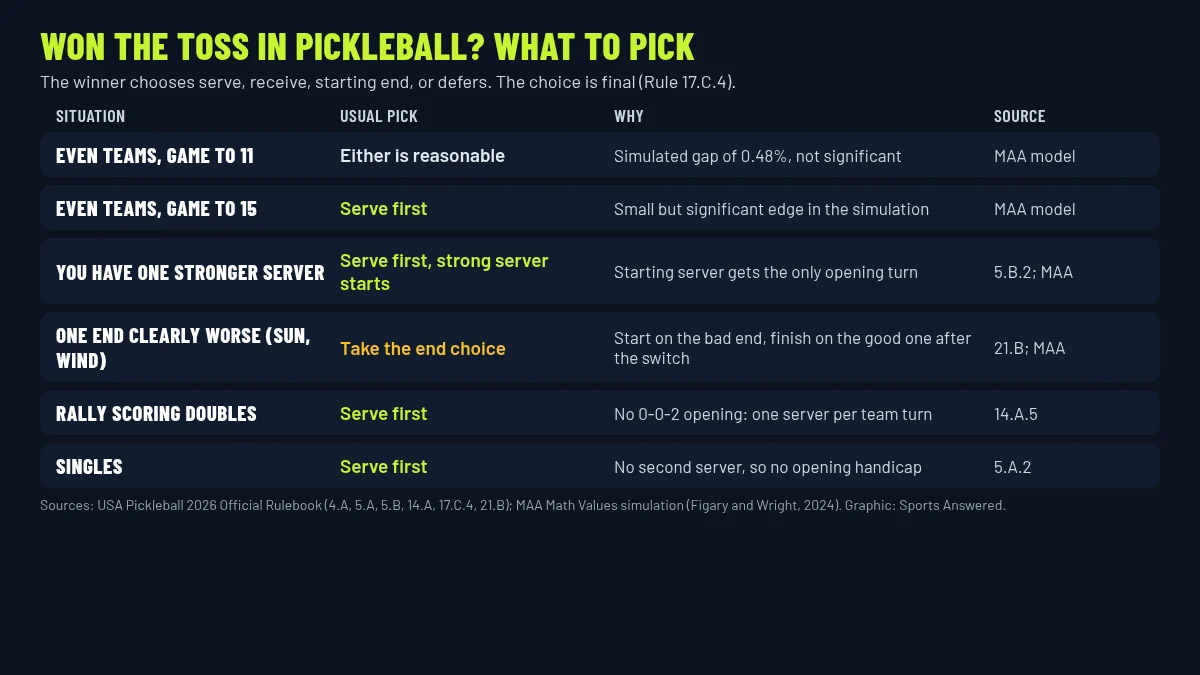
- Equal servers, game to 11. The team serving first did slightly worse, a gap the authors put at 0.48%. Their own test found that gap was not statistically significant.
- Equal servers, game to 15. Serving first gave a small advantage that did pass their significance test.
- One strong server on each team. Serving first with the strong server starting gave a noticeable edge. Serving first but keeping the strong server for second did clearly worse, a setup the authors called awful.
- One end clearly better than the other. The team that finished the game on the better end won far more often, whether or not it served first.
Treat these as model results, not proof from real matches. The simulation assigns skill levels and side advantages as fixed numbers, and real players get tired, adjust and get nervous. The direction of the findings still lines up with the rules above.
When the end matters more than the serve
Outdoors, the end you start on can matter more than who serves. Low sun in your eyes on one side, or a steady wind blowing toward one baseline, can tilt a game.
In a single game to 11, players change ends when the first team reaches 6 (Rule 21.B.1). That is why the MAA authors advise starting on the worse end: you suffer it early, then play the closing points, where games are decided, on the better end. Their summary advice for a team with the first choice was to pick the starting end when one side is clearly worse, and otherwise to serve first.
Match format changes the math. In a best 2-of-3 match to 11, which is a standard tournament format (Rule 15.C.1.a), there is no mid-game end change in games one and two. Players change ends and initial service between games (Rule 21.F.2), and the end change at 6 applies to the third, tie-breaker game. So the team that starts on the bad end plays all of game one there, all of game two on the good end, and finishes game three on the good end. The end change time-out itself is up to one minute (Rule 21.B.5); see our guide to pickleball time-out and end change rules.
Singles, rally scoring and rec play
Singles. There is no first and second server, so the short opening turn does not exist. The server keeps serving until losing a rally (Rule 5.A.2). Serving first simply gives you the first chance to score. Our singles scoring guide covers the two-number score call.
Rally scoring. USA Pickleball lists rally scoring as a provisional option. A point goes to whoever wins each rally, and only one partner serves before each side out (Rules 14.A.2 and 14.A.5). So the head start from serving first comes without the short opening turn that offsets it in standard doubles.
Rec play. If your open-play game is a single game to 11 and your group follows the tournament end change at 6, the end-choice advice above applies directly. If your group does not change ends at all, the bad end stays bad for one team all game, so the end choice is worth even more.
A quick decision routine at the toss
- Check the conditions. If sun or wind clearly favors one end, take the end choice and start on the worse end.
- Check your servers. If one partner's serve is clearly more reliable, choose to serve and put that player on the right side to start.
- Check the format. Rally scoring or singles: serve first. Even doubles teams in a game to 11: either choice is fine, so pick the one that settles your nerves.
- Say the score. The first serve of a doubles game is called "zero, zero, two." If you are unsure how points are won, see whether you can score when you are not serving, or keep track with our pickleball score keeper.
These rulings come from the 2026 USA Pickleball Official Rulebook, the edition in force when we checked on 2 November 2026.
Quick questions
- Why do some teams choose to receive first?
Because the serving team's first turn is short. At the start of each game only one player on the serving team serves before the side out (Rule 5.B), so the receiving team then gets a full two-server turn. The simulation we cite did not find receiving first to be an advantage when the better server starts for the serving team.
- Who should be the starting server on our team?
Your more reliable server. The starting server is the only player who serves in your team's first turn of the game (Rule 5.B.2), and in the MAA simulation, saving the better server for second was the setup the authors called awful for the team serving first.
- Does serving first matter in rally scoring?
Less. In rally scoring either team can win a point on any rally (Rule 14.A.2) and only one player per team serves before each side out (Rule 14.A.5), so there is no 0-0-2 opening turn to weigh.
- Can you change your mind after picking at the toss?
Not in a refereed match. Once the selection is made it cannot be changed (Rule 17.C.4).
- Who serves first in game two?
The other team. Between games, players change ends and the initial service passes to the opponents (Rule 21.F.2). Teams may also change their starting server between games.
Rulebook sources
- 2026 Official Rulebook (Rules 4.A, 5.A, 5.B, 14.A, 15.C, 17.C.4, 21.B, 21.F), USA Pickleballusapickleball.org
- Should You Choose to Serve First in a Pickleball Match? (Figary and Wright, 22 August 2024), Mathematical Association of Americamaa.org
Rule statements were checked against these sources on November 2, 2026. See a mistake? Read our corrections policy or email contact@sportsanswered.com.
Who answered
Sports Answered Editorial Team. Researched against the official rules, written and fact-checked by our editors. How we answer
Expert review
Reviewed by Linda Conrad on November 2, 2026.