Where to Stand When Receiving a Pickleball Serve (and Where Your Partner Goes)
The rulingDiagonal, on your score side
Stand in the service court diagonally opposite the server, on the side your team's score puts you: in doubles, your team's starting server is on the right when your team's score is zero or even and on the left when it's odd (USA Pickleball Official Rulebook, Rule 5.B.3). Most receivers stand near or behind the baseline, because the serve must bounce before you hit it (Rule 10.A). Your partner takes the other side of your court.
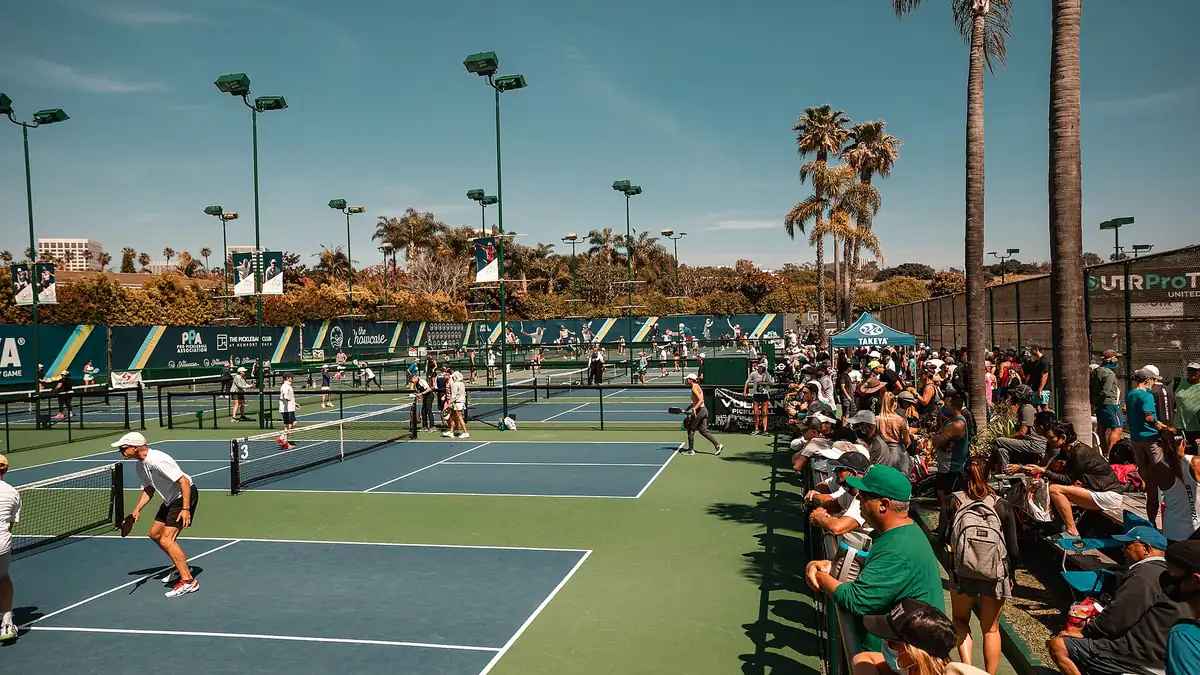
The rules that decide where you stand
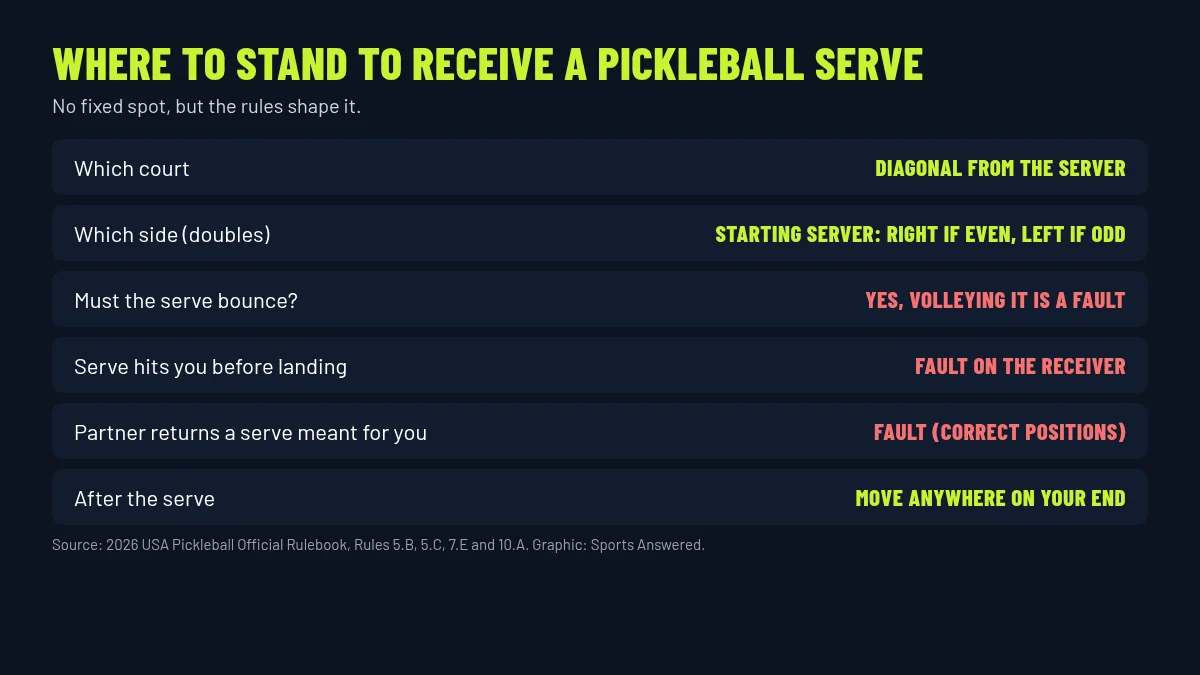
| Rule | What it means for the receiver | Rulebook |
|---|---|---|
| The serve goes diagonal | You receive in the service court diagonally opposite the server | 7.E |
| Your side comes from your score | Starting server right at zero or even, left at odd (doubles) | 5.B.3 |
| Only the correct receiver may return it | If your partner returns a serve meant for you, it's a fault | 5.C.1.c |
| You must let it bounce | Volleying the serve is a fault against the receiver | 10.A.1 |
| The serve must clear the non-volley zone | A serve landing in the kitchen is a fault on the server | 7.E.2 |
| Lines count as in | The service court includes its baseline, sideline and centerline | 3.A.4.f |
| A serve that hits you is your fault | If the serve hits you or your partner before landing, it's a fault on the receiver | 7.E.5 |
| After the serve, move freely | No position limits once serving and receiving are done, on or off the court | 5.B.4 |
Singles: the server's score decides
In singles, your side as receiver depends on the server's score, not yours. Rule 5.A.1 says that when the server's score is zero or even, the serve is made from the right and received in your right service court. When the server's score is odd, it comes from the left and you receive in your left service court (2026 Official Rulebook).
| Server's score | Server serves from | You receive in |
|---|---|---|
| 0, 2, 4, 6... | Right serving area | Your right service court |
| 1, 3, 5, 7... | Left serving area | Your left service court |
Doubles: your team's score decides
In doubles, each team positions by its own score (Rule 5.B.3). When your team's score is zero or even, your team's starting server stands on the right and their partner on the left. When it is odd, they switch. The receiver is whichever of you is standing in the court diagonal to the server.
A worked example: the score is called "4-3-1." The serving team has 4 and the receiving team has 3. Your team, receiving, has an odd score, so your starting server is on the left and your partner is on the right. If the server is serving from the right, the player on your right receives.
Because the receiving team does not switch sides when it wins a rally, your positions change only when your own score changes, which happens only when you are serving.
Why receivers stand deep
The rules don't set a spot. They do shape it. The serve has to clear your non-volley zone and land in your service court, which runs back to and includes the baseline (Rules 7.E and 3.A.4.f). You have to let it bounce before you hit it. Standing at or behind the baseline means a deep serve bounces in front of you rather than at your feet.
Standing too close also risks the serve hitting you before it lands. Rule 7.E.5 makes that a fault against the receiving side, not a redo.
Where your partner stands
Your partner's correct position is on the opposite side of your court from you, based on your team's score (Rule 5.B.3). There's no rule about how far forward they stand. Once the serve is in play, Rule 5.B.4 says there's no restriction on where players stand, on or off the court, as long as they stay on their own end of the net.
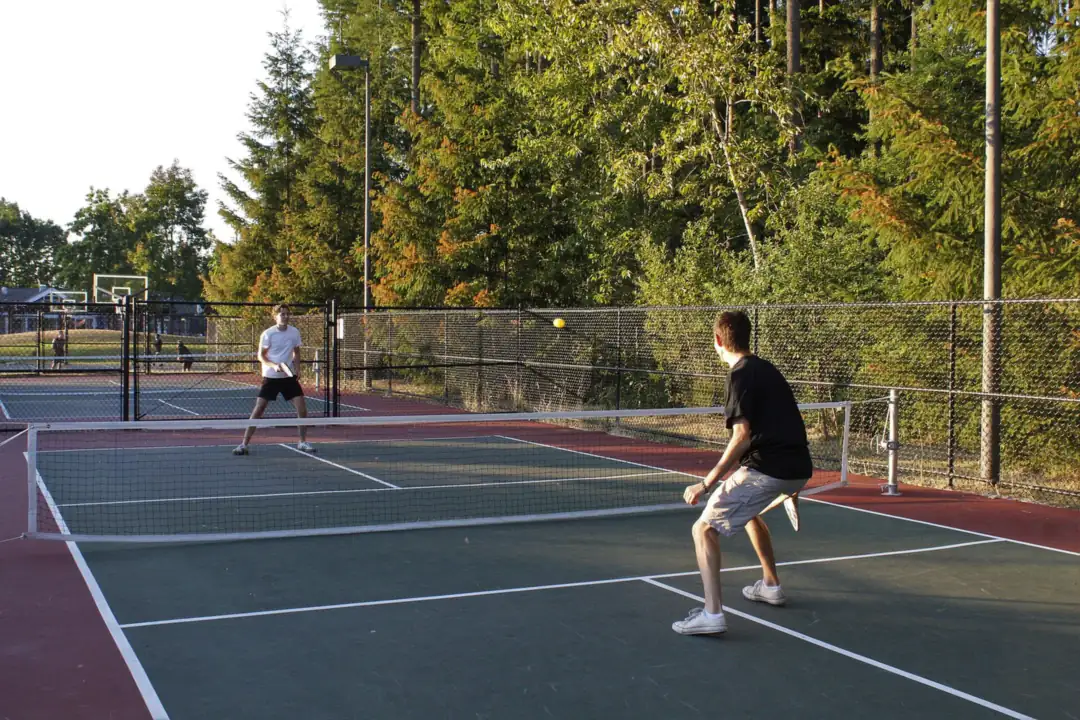
The two-bounce rule also limits the serving team: they must let your return bounce before hitting it (Rule 10.A.2). That's why the receiving team often has a partner near the non-volley zone line while the serving team waits back. USA Pickleball's own coaching page on positioning puts it this way: on the returning team, only the player receiving the serve should start behind the baseline, and the non-receiving partner should already be at the kitchen line (USA Pickleball). That is strategy advice, not a rule, so a beginner who feels safer starting back can do so legally.
Before the serve: get ready, then stay put
The rulebook gives the receiver a few protections before the serve:
- Signal "not ready." Before the score call starts, any player may signal not ready by raising the paddle or the non-paddle hand above the head, or by turning their back to the net (Rule 6.A.1). Once the score call starts, those signals no longer count, except to indicate a hinder (6.A.2).
- The score waits for you. The score must not be called until the server and receiver are, or should be, in position and all players are, or should be, ready (Rule 6.B).
- Ask the score. Before the serve, you may ask the opponent for the correct score, and they must answer (Rule 6.E.1).
- The server can't rush you. The whole score must be called before the serve is hit; serving during the call is a fault on the server (Rule 6.C.1). The server then has 10 seconds to serve (Rule 6.D).
If the serving team changes serving areas after the score is called, the server must let all players reposition and then re-call the score (Rule 6.D.2).
Not sure which side you're on?
Ask. Before the serve, any player may ask the opponents who the correct server or receiver is (Rule 5.C). If nobody notices a position mix-up until the rally is over, the result stands (Rule 5.C.2). Our guide to who serves in pickleball and the serving order walks through how the score sets every player's position.
Calling the serve in or out
Players are responsible for "out" calls on all lines on their own end of the court, and in doubles either partner may make the call (Rule 8.A). Lines are part of the service court, so a serve that touches your baseline, sideline or centerline is in. A serve that touches your non-volley zone line counts as landing in the kitchen, because the lines are part of the zone, and that's a fault (Rules 3.A.4.c and 7.E.2). Before you call a serve fault for its motion or drop, check our legal pickleball serve checklist.
Quick questions
- Does the receiver have to stand behind the baseline in pickleball?
No. The rulebook doesn't require the receiver to stand behind the baseline. The receiver must be the correct player on the correct side, and must let the serve bounce before hitting it. Standing back simply gives you room to do that.
- Where should the receiver's partner stand?
On the opposite side from the receiver, as set by the team's score. Beyond that, the rules don't fix a spot, and once the serve is hit there's no restriction on where players stand, as long as they stay on their own end.
- Can the receiver stand in the kitchen?
Nothing stops you from standing in the non-volley zone while waiting, but you can't volley the serve or the ball you return from there. The serve has to bounce first anyway, and it must land beyond the non-volley zone to be good.
- What if my partner returns a serve meant for me?
If the right players were in the right positions, it's a fault against the player who returned it, even if the rally is played out, as long as it's called before the next serve.
Rulebook sources
- 2026 Official Rulebook (Rules 3.A.4, 5.B, 5.C, 7.E, 8.A, 10.A), USA Pickleballusapickleball.org
- Pickleball Rules Summary, USA Pickleballusapickleball.org
- Pickleball Basics: Positioning, Patience, and Kitchen Line Strategy, USA Pickleballusapickleball.org
Rule statements were checked against these sources on October 21, 2026. See a mistake? Read our corrections policy or email contact@sportsanswered.com.
Who answered
Sports Answered Editorial Team. Researched against the official rules, written and fact-checked by our editors. How we answer
Expert review
Reviewed by Linda Conrad on October 19, 2026.