What Happens If You Serve From the Wrong Side in Tennis? Points Stand, Switch Now
The rulingPoints stand; switch sides now
If you serve from the wrong side in tennis, nothing is replayed. Every point already played stands, you move to the correct half of the court as soon as anyone notices, and you keep going from the current score. That comes from Rule 27a of the ITF 2026 Rules of Tennis, which the USTA also uses.
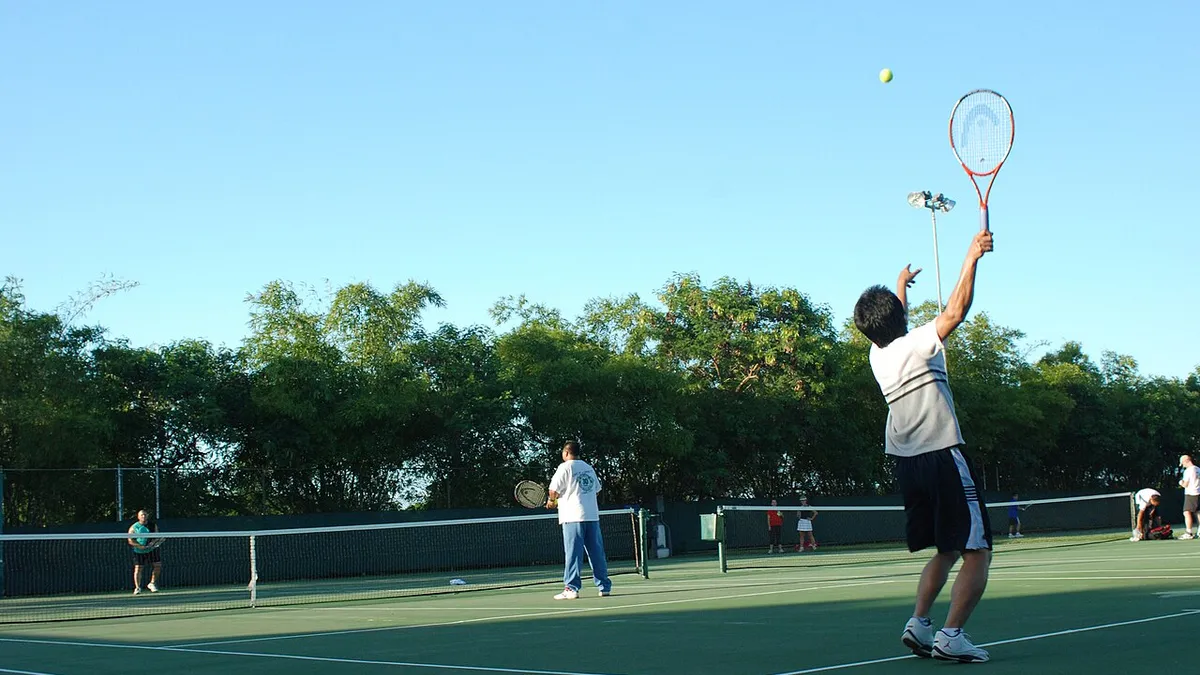
There is one catch. If you had already missed a first serve from the wrong half before the mistake was spotted, that fault still counts. Your next serve is a second serve, and Rule 20 says you hit it from the correct half rather than the one you just faulted from.
The rule in one line
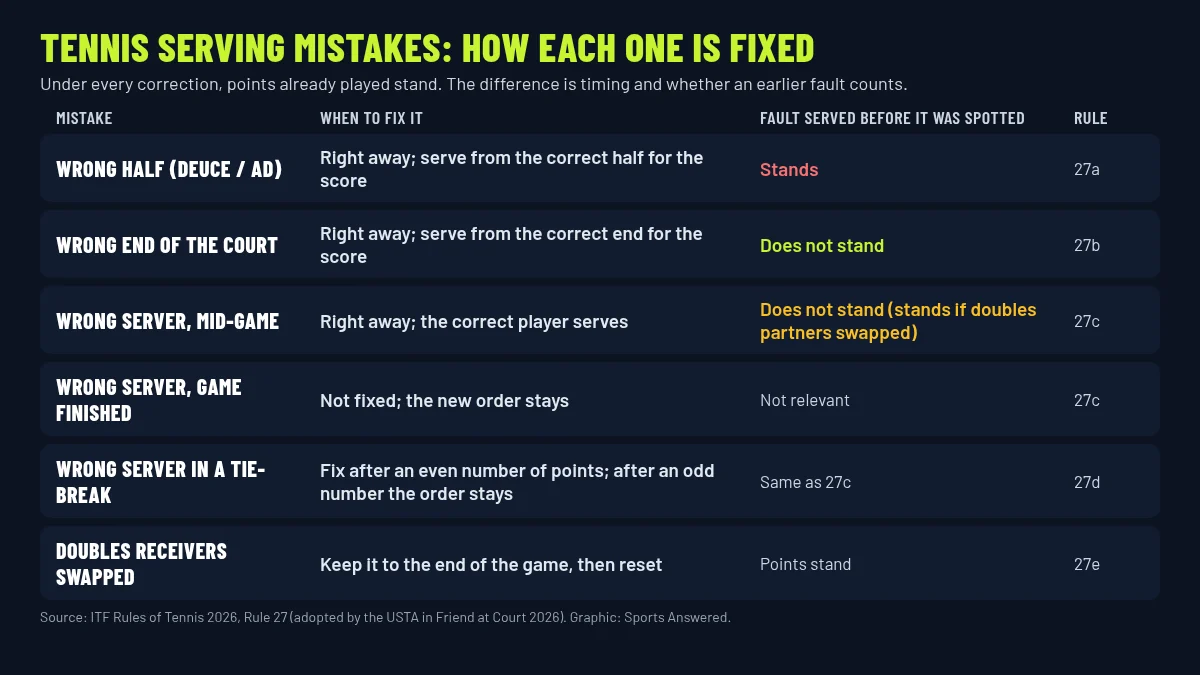
Rule 27 opens with the principle that settles almost every argument: when an error is discovered, "all points previously played shall stand." The lettered parts of the rule then say how to fix each kind of mistake from that moment on. Nobody loses a point for having served from the wrong half, and nobody gets a point back either.
Every serving mix-up, and how it is fixed
The wrong side is only one of several mistakes Rule 27 covers. They are easy to confuse, and the fault rules are different for each.
| Mistake | What you do | Does an earlier fault count? | Rule |
|---|---|---|---|
| Server on the wrong half (deuce or ad) | Switch to the correct half for the score right away | Yes, it stands | 27a |
| Players at the wrong ends of the court | Change to the correct ends right away | No, it does not stand | 27b |
| Wrong player serving, caught mid-game | The player originally due to serve takes over | No, if the opponent served it. Yes, if it was the server's own doubles partner | 27c |
| Wrong player served a whole game | Leave it. The serving order stays as it now is | Not relevant | 27c |
| Wrong player serving in a tie-break | Correct it if an even number of points have been played; after an odd number, the order stays | Same as 27c | 27d |
| Doubles receivers on the wrong sides | Keep the swapped order to the end of the game, then go back to the original order | Points stand | 27e |
When the wrong player serves a whole game and the order stays altered, Rule 27c adds a small housekeeping step: any ball change due after a set number of games moves one game later than planned.
Working out the correct side from the score
Rule 17 says the server starts every standard game from behind the right half of the court and alternates halves after each point. That gives a simple check you can do from the score alone: add up the points played in the game.
| Points played in the game | Example scores | Serve from |
|---|---|---|
| Even | 0-0, 15-15, 30-0, 0-30, 40-15, deuce | Right half (deuce court) |
| Odd | 15-0, 0-15, 30-15, 40-30, advantage | Left half (ad court) |
Tie-breaks work the same way. Rule 17 says the first point of a tie-break is served from the right half, and serves then come from alternate halves. If you are not sure who should be serving in the tie-break at all, our guide to how a tennis tiebreak works walks through the order point by point.
Two worked examples
Served from the ad side at 30-15. Three points have been played, an odd number, so you should be on the left (ad) half. Say you served the 30-15 point from the right half instead, missed your first serve, and your opponent then pointed it out. Rule 27a applies: the fault stands, so you are on your second serve, and you hit it from the left half. The earlier points in the game do not change.
Wrong ends, found after a first-serve fault. Here Rule 27b applies instead, and its last sentence is the opposite of 27a: a fault served before the error was discovered "shall not stand." You change ends and start the point again with a first serve. USTA's What's the Call page on serving from the wrong end covers a singles match where the players forgot to change ends and noticed in the middle of the fourth game. The answer: correct it immediately, even if one player would rather finish the game first.
Doubles: the receivers are on the wrong sides
In doubles, the receiving team picks who receives the first point of their first receiving game in each set, and then the partners alternate. If they get that rotation wrong partway through a game, Rule 27e says the altered order stays until the end of that game. The next time they receive in that set, they go back to their original order. USTA answered this exact case in Serving to the wrong side, where a team noticed after a long rally that they had received from the wrong sides. The altered order stays to the end of the game, and the team returns to its original order the next time it receives. Under the Rule 27 principle, the rally they just played stands.
Is a serve from the wrong half a fault?
Rule 19a lists breaking Rule 17, the rule that sets out alternate halves, among the causes of a service fault. Rule 27a is the part that deals with an error discovered later: points already played stand, a fault served before the discovery stands, and the server moves to the correct half. Neither rule lets a player claim back a point that has already finished. If you notice the server is on the wrong half before the serve, say so then, when fixing it costs nobody anything.
Stopping the mistake before it happens
In matches without an official, the USTA Code (item 31 in the 2026 Friend at Court) says the server must announce the game score before the first point of a game and the point score before every point after that. Saying the score out loud is the easiest way to catch a wrong side, because the score tells you the side.
If the players cannot agree on the score, or on which court a disputed point started from, Code item 32 lists the ways to settle it in order of preference:
- Count all the points and games the players agree on and replay only the disputed ones. If you do not agree on which court the disputed point started in, toss a coin to choose the court.
- Play from a score that all players agree to.
- Spin a racket or toss a coin.
Keeping score on a phone with our tennis score keeper helps too: if the score is right, the side is right. If your mix-up was about who serves in the first place rather than where, see who serves first in tennis.
Quick questions
- Do you replay the point if you served from the wrong side in tennis?
No. Under ITF Rule 27, every point already played stands. You move to the correct half as soon as the mistake is noticed and carry on from the current score.
- Does a fault count if it was served from the wrong side?
Yes. Rule 27a says a fault served from the wrong half before the error was discovered stands. Your next serve is a second serve, hit from the correct half (Rule 20).
- What if we were at the wrong ends of the court?
Fix it as soon as you notice and serve from the correct end for the score. Points already played stand, but a fault served before the error was found does not stand (Rule 27b), so you get a fresh first serve.
- What if the wrong player served a whole game?
If the game was completed before anyone noticed, the result stands and the serving order stays as it now is (Rule 27c). If it is caught mid-game, the player originally due to serve takes over straight away.
- How do I know which side to serve from?
Every game starts from the right half (Rule 17) and you alternate after each point. When the total number of points played in the game is even (0-0, 15-15, 30-0), serve from the right. When it is odd (15-0, 30-15, 40-30), serve from the left.
Rulebook sources
- ITF 2026 Rules of Tennis (Rules 17, 19, 20 and 27), International Tennis Federationitftennis.com
- USTA 2026 Friend at Court (The Code, items 31 and 32), USTAusta.com
- What's the Call: Serving to the wrong side, USTAusta.com
- What's the Call: Serving from the wrong end, USTAusta.com
Rule statements were checked against these sources on October 31, 2026. See a mistake? Read our corrections policy or email contact@sportsanswered.com.
Who answered
Sports Answered Editorial Team. Researched against the official rules, written and fact-checked by our editors. How we answer
Expert review
Reviewed by John Craig on October 31, 2026.