How to Score Pickleball Singles (With a Rally-by-Rally Example)
The rulingTwo numbers, server scores only
In pickleball singles, only the server can win a point, and the score is called as two numbers: the server's score first, then the receiver's, starting at "zero-zero." You serve from the right side when your own score is even (including zero) and from the left when it is odd, switching sides after every point you win. When you lose a rally you lose the serve (a side out) and no point is scored. Games are normally to 11, win by 2 (2026 USA Pickleball Official Rulebook, Rules 4.A, 5.A and 6.B.1).
The four rules that run every singles game
- Only the server scores. A point is scored by serving and winning the rally (Rule 4.A).
- Call two numbers. Server's score, then receiver's score. The first serve of each game is "zero-zero" (Rule 6.B.1). The full score must be called before you hit the serve, and you then have 10 seconds to serve (Rules 6.C and 6.D).
- Your score picks your side. Even or zero: serve from the right serving area into your opponent's right service court. Odd: serve from the left into their left service court (Rule 5.A.1).
- Keep serving until you lose a rally. After each point you switch sides and serve again. Lose a rally and it is a side out (Rules 5.A.2 and 5.A.3).
That is the whole system. The confusing part for most players is how the positions move, so here is a short game played out.
A singles game, rally by rally
Ana serves first against Ben. Follow the score call and the side each player serves from.
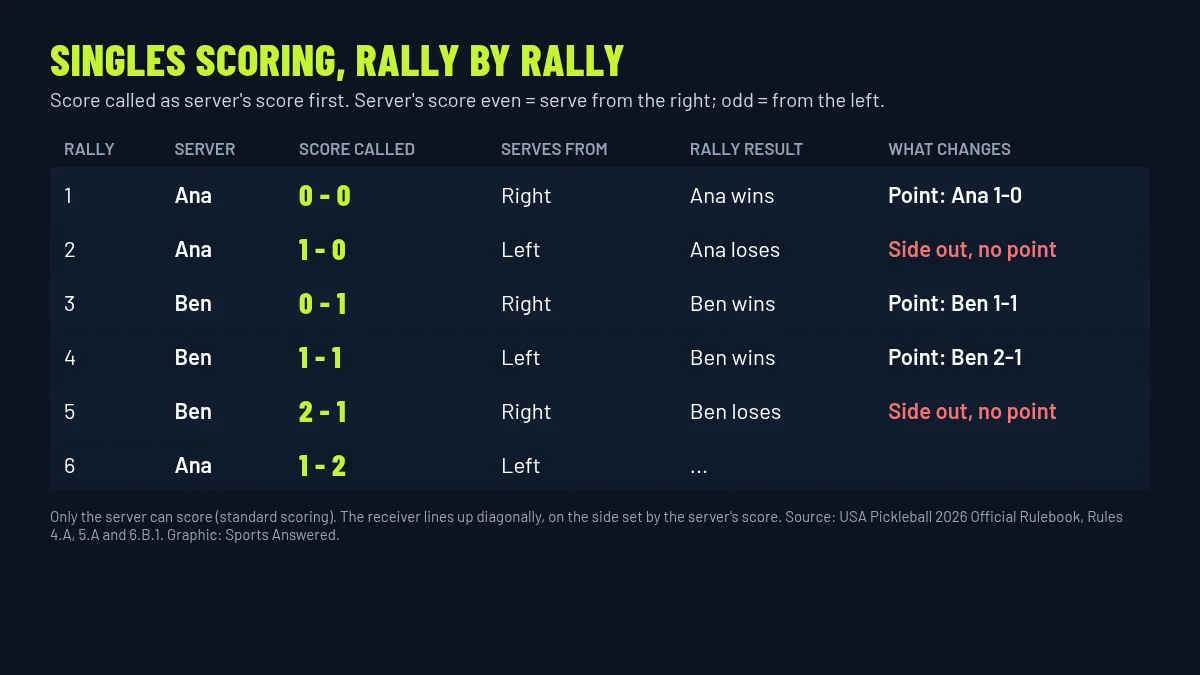
| Rally | Server | Score called | Serves from | Result |
|---|---|---|---|---|
| 1 | Ana | 0-0 | Right (0 is even) | Ana wins the rally: Ana 1, Ben 0 |
| 2 | Ana | 1-0 | Left (1 is odd) | Ana loses the rally: side out, no point |
| 3 | Ben | 0-1 | Right (Ben has 0) | Ben wins: Ben 1, Ana 1 |
| 4 | Ben | 1-1 | Left | Ben wins: Ben 2, Ana 1 |
| 5 | Ben | 2-1 | Right | Ben loses: side out, no point |
| 6 | Ana | 1-2 | Left (Ana has 1) | Play continues |
Notice two things. First, the score always flips when the serve changes hands: Ben's "0-1" in rally 3 is the same score as Ana's "1-0" in rally 2, said from his side. Second, after a side out the new server does not start on the right automatically. Ana serves rally 6 from the left because her score, 1, is odd. Our pickleball score keeper has a singles mode that tracks the score and the serving side for you.
The mistake most players make: the receiver's position
The receiver does not line up by their own score. In singles, the positions of both players are set by the server's score (Rule 5.A). If the server has 3 and you have 0, the server is on the left and you receive in your left service court, even though your own score is even.
A quick check that works on any point: if the server is standing on the side that matches their score (even right, odd left), the receiver simply stands diagonally across. If the server is on the wrong side for their score, someone has lost track. You may ask your opponent for the score before the serve, and they must tell you (Rule 6.E.1).
How singles scoring differs from doubles
| Singles | Doubles | |
|---|---|---|
| Score call | Two numbers: server, receiver | Three numbers: serving team, receiving team, server number |
| Start of game | "Zero-zero" | "Zero-zero-two" |
| Serves per side | One player serves until a rally is lost | Both partners serve before a side out (except the first turn of the game) |
| Side you serve from | Set by your own score | Set by your team's score and who started the game |
| Who scores | Server only | Serving team only |
Sources: Rules 5.A, 5.B, 6.B.1 and 6.B.2. If you also play doubles, our guide to who serves in pickleball and the doubles serving order walks through the first-server and second-server rotation.
Rally scoring in singles
The rulebook also has a provisional rally scoring option (Rule 14.A). Every rally wins a point, whoever served. The score is still called as two numbers, and the server still picks a side by their own score. If the receiver wins the rally, they score the point and take over the serve.
Rally scoring is not allowed everywhere in 2026. A tournament director may use it for most events, but not for double-elimination doubles, any 2026 USA Pickleball Golden Ticket event or the 2026 USA Pickleball National Championships (Rule 15.C.2). Rally scoring games can be to 11, 15 or 21.
Mini-singles: half the court, your own score
Mini-singles (Rule 14.B) is a half-court version of singles played on a normal court. Only the right or left half on each end is in play for a rally, and the side is set by each player's own score, not the server's. An extra line extends the centerline through each non-volley zone so you can see the half-court boundary. Shots must land in the half of the opponent's court that is in play.
Tournament formats, end changes and time-outs
All tournament scoring options are win by 2 points (Rule 15.C). The standard formats are:
- Best two of three games to 11
- Best three of five games to 11
- One game to 15 or 21
- One game to 11 (round robins with six or more teams only)
In a single-game match or the deciding game, players change ends when the first player reaches 6 in a game to 11, 8 in a game to 15, or 11 in a game to 21. The same server keeps serving after the change (Rule 21.B). Each player gets two standard one-minute time-outs in games to 11 or 15 and three in a game to 21 (Rule 21.A).
Serving in singles: the rules don't change
Singles uses the same serve rules as doubles: the same foot position, the underhand motion or drop serve, and the serve must clear the non-volley zone. Our checklist on whether your pickleball serve is legal covers each requirement.
Quick questions
- Do you say three numbers in pickleball singles?
No. Singles uses two numbers: the server's score, then the receiver's score. The third number in doubles is the server number (1 or 2), and singles has only one server per side.
- Can the receiver score a point in singles?
Not with standard scoring. Only the server scores. If the receiver wins the rally it is a side out and the receiver becomes the server. With the rally scoring option (Rule 14.A), the winner of every rally scores.
- Where does the receiver stand in singles?
Diagonally across from the server, on the side set by the server's score. Server's score even: both players on the right. Server's score odd: both on the left. The receiver's own score does not decide it.
- What score do singles games go to?
Usually 11, win by 2. Tournaments can also play one game to 15 or 21, or best of three or five games to 11, all win by 2.
- Does the first server in singles get only one serve, like in doubles?
There is no first-server exception in singles. The player who serves first keeps serving until they lose a rally, then it is a side out. The 'zero-zero-two' start applies to doubles only.
Rulebook sources
- 2026 USA Pickleball Official Rulebook (Rules 4.A, 5.A, 6.B.1, 14.A, 14.B, 15.C, 21.A, 21.B), USA Pickleballusapickleball.org
Rule statements were checked against these sources on October 27, 2026. See a mistake? Read our corrections policy or email contact@sportsanswered.com.
Who answered
Sports Answered Editorial Team. Researched against the official rules, written and fact-checked by our editors. How we answer
Expert review
Reviewed by Sara McInnes on October 27, 2026.