What Is Not Allowed in Pickleball? Every Fault in the 2026 Rules, Plus 7 Myths
The ruling42 listed faults; the kitchen volley tops the list
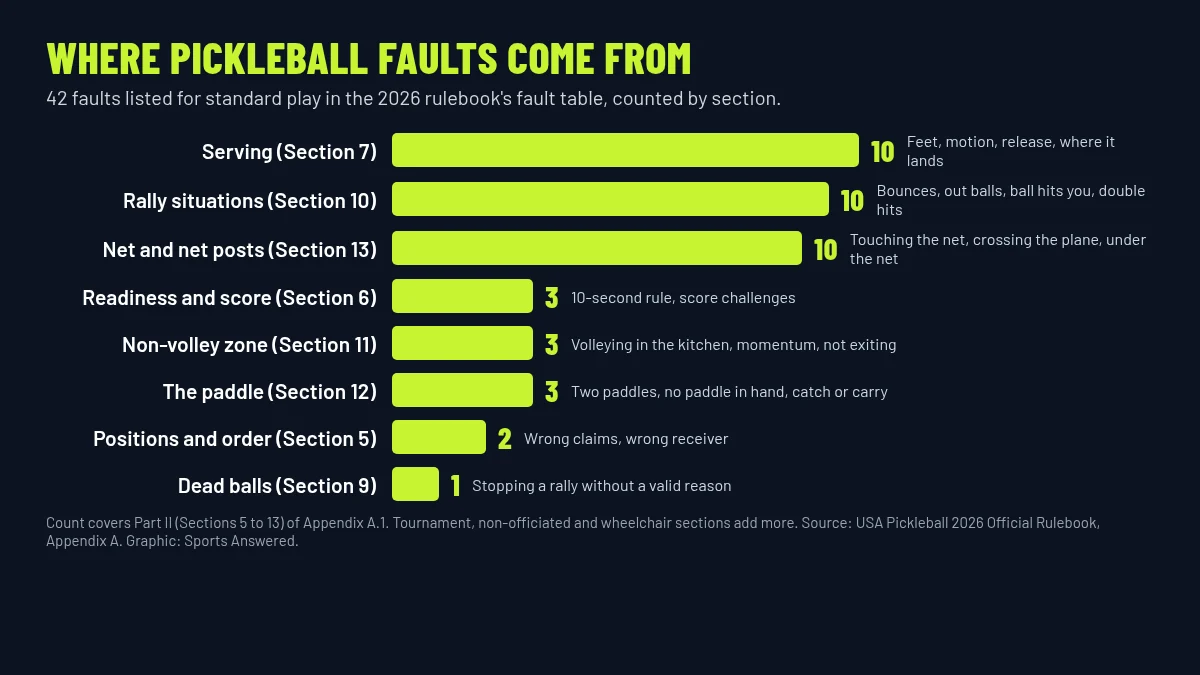
In pickleball you may not volley while touching the kitchen, volley the serve or the return of serve, let the ball bounce twice, hit it out, touch the net while the ball is live, reach over the net before the ball crosses, catch or carry the ball on your paddle, use two paddles, or let the ball hit your body. The 2026 rulebook's own fault table lists 42 faults for standard play across Sections 5 to 13 (2026 USA Pickleball Official Rulebook, Appendix A.1).
A fault ends the rally. If the serving side commits it, they lose the serve. If the receiving side commits it, the server's side wins the point.
What is not allowed, area by area
Each row below is a fault in the 2026 rules. The rule number is there so you can check it yourself.
| Area | Not allowed | Rule |
|---|---|---|
| Serve | Both feet off the ground, a foot on the court, or a foot outside the serving area when you hit | 7.A.1 to 7.A.3 |
| Serve | Volley serve that is not an upward arc, with the paddle head above the wrist, or contact above the waist | 7.C.1 to 7.C.5 |
| Serve | Drop serve thrown, pushed or dropped from an aided height | 7.D.1, 7.D.2, 7.D.6 |
| Serve | Serve landing in the kitchen, out, or hitting a permanent object | 7.E.1 to 7.E.3 |
| Serve | Taking more than 10 seconds to serve after the score is called | 6.D.1 |
| Bounces | Volleying the serve, or volleying the return of serve | 10.A.1, 10.A.2 |
| Bounces | Letting the ball bounce twice | 10.B.1 |
| Rally | Hitting out, failing to get it over the net, or hitting a permanent object | 10.C.1, 10.C.2, 10.C.4 |
| Rally | Ball hitting your body or clothing (paddle hand below the wrist excepted) | 10.C.3 |
| Rally | Double hit that is not one continuous stroke, or both partners hitting it | 10.D.1, 10.D.2 |
| Kitchen | Volleying while you, or anything touching you, is in the zone | 11.A.1 |
| Kitchen | Momentum carrying you into the zone after a volley, even after the ball is dead | 11.A.2 |
| Kitchen | Volleying before both feet are back outside the zone | 11.A.3 |
| Paddle | Using or carrying two paddles, hitting without holding the paddle, catching or carrying the ball | 12.A.1, 12.B.1, 12.C.1 |
| Net | Touching the net or its support system while the ball is live | 13.G.1 |
| Net | Hitting between the net and the post, or under the net | 13.D.1, 13.E.1 |
| Net | Hitting the ball before it fully crosses to your side | 13.F.1 |
| Net | Crossing the net plane before you hit, or touching your opponent or their court | 13.I.1.a, 13.H.1 |
| Conduct | Distracting an opponent who is about to hit | 10.F |
| Conduct | Stopping a rally without a valid reason | 9.A.1 |
The kitchen rule people get wrong
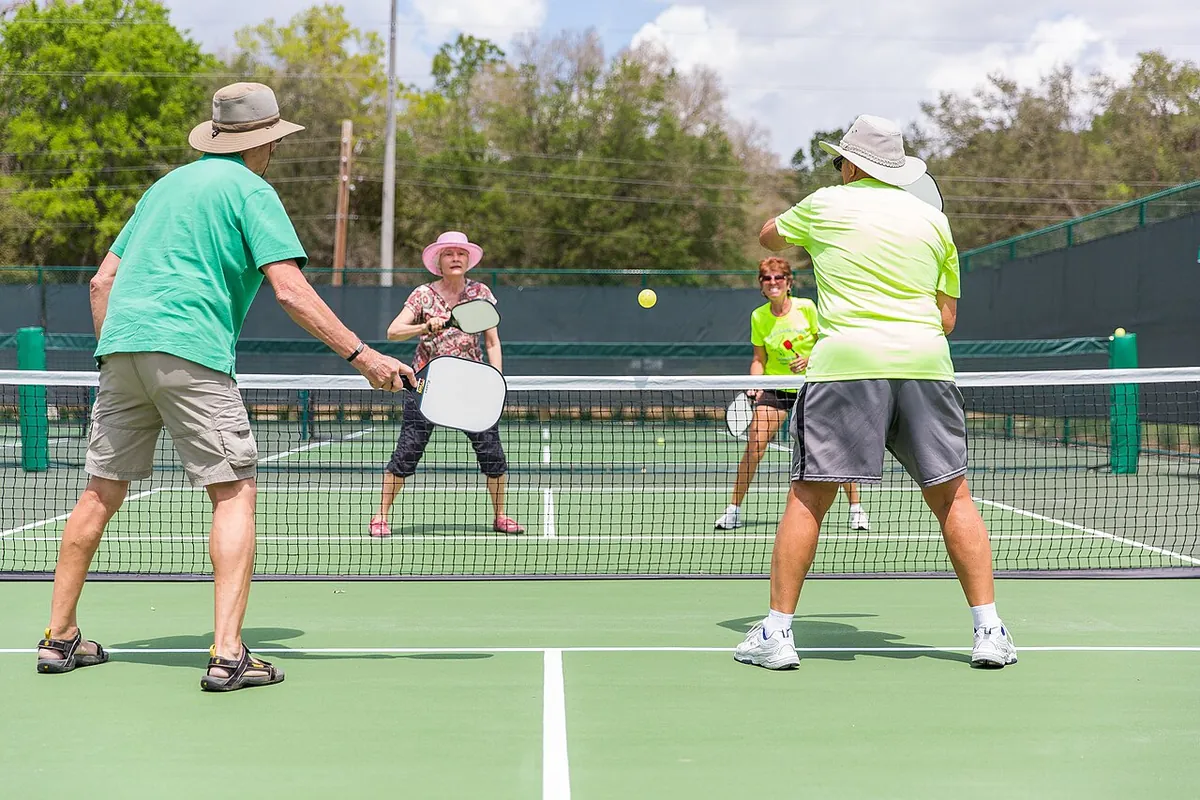
The non-volley zone is the area that runs 7 feet from the net on each side. The rule is about volleys, not about standing. Rule 11.A says all volleys must start outside the zone, and that a player "may contact the non-volley zone at any time except during the act of volleying a ball."
So you can walk in, stand in it and hit a ball that has bounced. Three things get called:
- Touching the zone, or the line, while you volley. Your partner counts too if they are touching you.
- Stepping or falling in after the volley because of your momentum. This is a fault even if the ball is already dead (11.A.2).
- Volleying with one foot still in the zone. Both feet must be back outside first (11.A.3).
If you are unsure where the zone starts, see whether the pickleball kitchen line is in or out.
Serving faults
Section 7 lists 10 faults, tied with Sections 10 and 13 for the most. Five are about where the serve lands or what it hits. Three are about your feet, and two are about your service motion.
The volley serve has three motion tests: the paddle moves in an upward arc, the paddle head is not above your wrist, and the ball is no higher than your waist at contact (7.C.1 to 7.C.3). The drop serve skips all three. You only need to drop the ball from a natural height without throwing it (7.D.1, 7.D.2).
Adding spin to the ball with your hand before the serve is not allowed either, but the penalty is a replay rather than a fault (7.B.2.a). For the full checklist, read how to check if your pickleball serve is legal.
Net faults
The net produces 10 listed faults. Touching it with your body, clothes or paddle while the ball is live is the common one (13.G.1). Reaching over to hit a ball that has not crossed to your side is another (13.F.1).
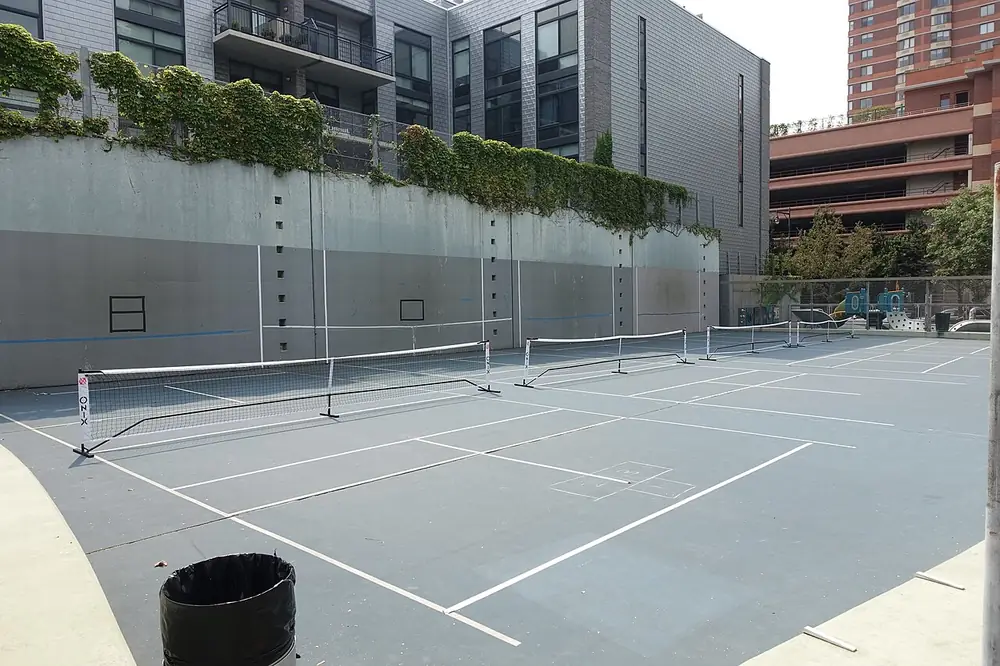
Portable nets have feet and crossbars on the court. A served ball that touches any part of that support system is a fault (13.B.1). We cover the post, the plane and the follow-through in detail in our guide to pickleball net rules.
Seven things that are allowed
Players often call these faults by mistake. The rulebook says otherwise.
| Often called a fault | What the rule says | Rule |
|---|---|---|
| Standing in the kitchen | Allowed any time you are not volleying | 11.A |
| Serve clips the net and lands in | Legal serve, play on | 7.E |
| Return goes around the net post | Legal; it does not have to go over the net | 13.C |
| Paddle crosses the net after you hit | Allowed during that strike and its follow-through | 13.I.1 |
| Two hands on the paddle, or switching hands | Allowed at any time | 12.B |
| Ball hits your paddle hand below the wrist | Treated like the paddle, no fault | 10.C.3 |
| Swinging and missing completely | The ball stays live | 10.E |
On the drop serve, the ball may bounce any number of times and anywhere before you hit it (7.D.3, 7.D.4). And a serve that touches the net is not replayed; see whether a pickleball serve can hit the net.
Who is allowed to call a fault?
In games without a referee, you call faults on yourself and your partner as soon as they happen (9.B.2). You may only call two kinds of faults on an opponent: non-volley zone faults and service foot faults (9.B.3).
For anything else you think your opponent did, such as a double hit or a net touch, you can mention it after the rally. You have no authority to enforce it. The decision belongs to the player who allegedly committed it (9.B.4). If the two teams disagree about a fault call, the rally is replayed (9.B.3.b).
Spectators do not count. The rules say they must not be consulted on any call (8.J).
Court rules are a separate list
Many park and club courts post their own rules at the gate. These are facility rules, not rules of the game.
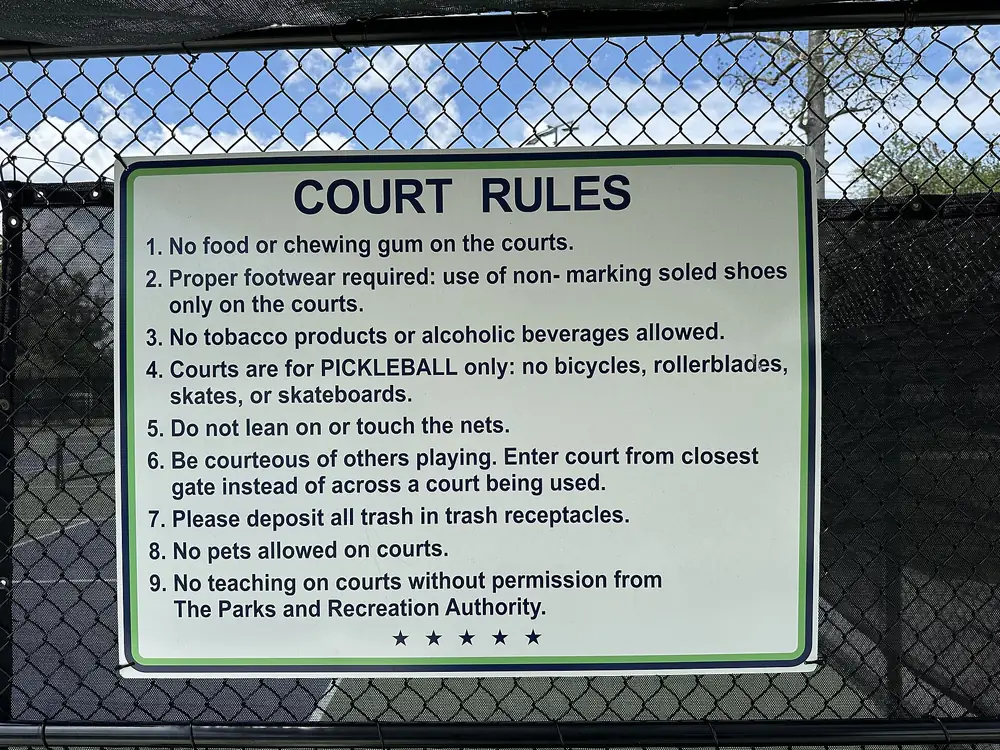
The sign above is typical: no food or gum, non-marking shoes only, no tobacco or alcohol, no bikes or skates, no leaning on the nets, no pets, and no teaching without permission. Breaking one of these can get you asked to leave. It is not a fault, and it does not cost a point.
Equipment is the other off-court list. Paddles used in sanctioned play must be on the USA Pickleball Approved Paddle List (3.D, 3.D.1); to check yours, see how to check if your pickleball paddle is legal.
Which rules this covers
All rule numbers are from the 2026 USA Pickleball Official Rulebook. Tournament play adds more faults in Part III (for example time-out and line-call rules), and wheelchair and adaptive play adds its own in Section 25. The short official version is the USA Pickleball rules summary.
Quick questions
- Can you stand in the kitchen in pickleball?
Yes. You may be in the non-volley zone at any time. What is not allowed is volleying the ball (hitting it before it bounces) while you or anything touching you is in the zone (Rule 11.A).
- Can you hit the ball with your hand in pickleball?
Only the hand holding the paddle, below the wrist. If the ball hits any other part of you or your clothing after the serve, it is a fault against you (Rule 10.C.3).
- Is it legal to hit the ball around the net post?
Yes. A return around the outside of the net post is legal and does not have to go over the net. Hitting it between the net and the post, or under the net, is a fault (Rules 13.C, 13.D and 13.E).
- Can I call a fault on my opponent in rec play?
Only non-volley zone faults and service foot faults. For anything else you may mention it after the rally, but the player who allegedly committed it decides (Rules 9.B.3 and 9.B.4).
- Can I switch hands or use two hands on the paddle?
Yes. You may hold the paddle with one or both hands and switch hands at any time. You must have the paddle in your possession when you hit the ball (Rule 12.B).
Rulebook sources
- 2026 USA Pickleball Official Rulebook (Sections 6, 7, 9, 10, 11, 12, 13 and Appendix A), USA Pickleballusapickleball.org
- Essential Pickleball Rules Summary for Beginners, USA Pickleballusapickleball.org
Rule statements were checked against these sources on October 28, 2026. See a mistake? Read our corrections policy or email contact@sportsanswered.com.
Who answered
Sports Answered Editorial Team. Researched against the official rules, written and fact-checked by our editors. How we answer
Expert review
Reviewed by Bob Savar on October 28, 2026.