Is the Pickleball Kitchen Line In or Out? Ball, Serve and Feet Explained
The rulingIn (rally) / Fault (serve)
It depends on what touched the line. A ball that lands on the kitchen line during a rally is in. A serve that touches the kitchen line is short, and a fault. And if your foot touches the kitchen line while you volley, that is a fault, because the line counts as part of the kitchen. All three come straight from USA Pickleball's rules.
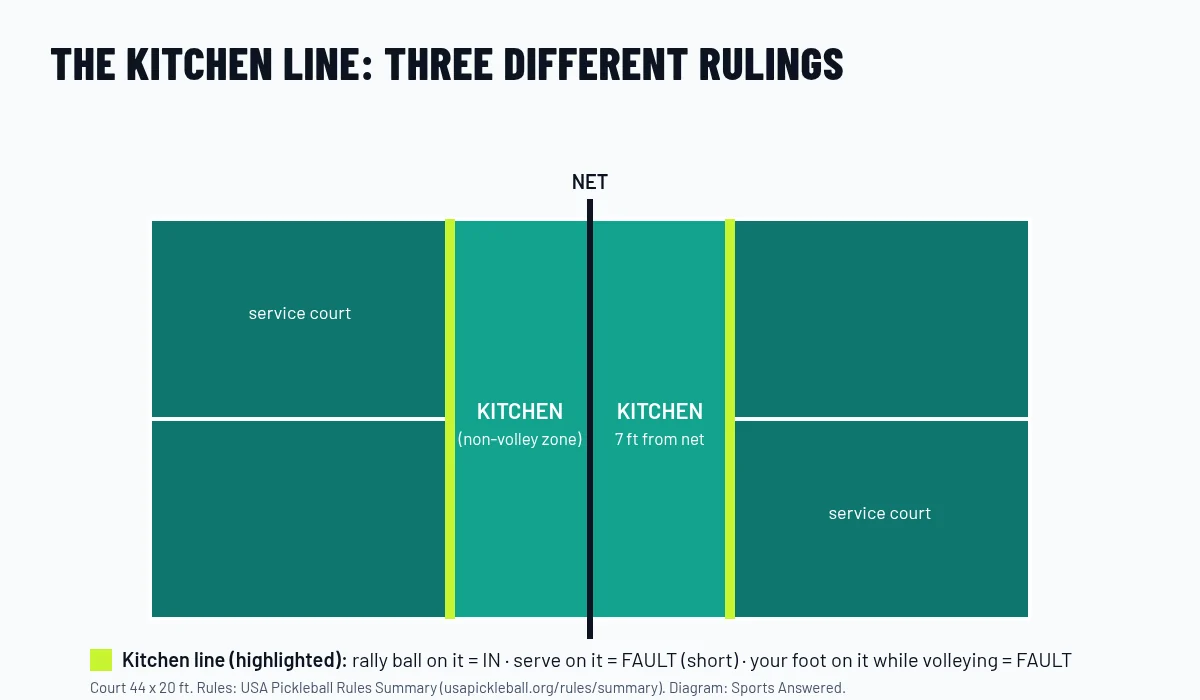
The three meanings of "in or out"
| Who or what touches the kitchen line | Ruling | Why |
|---|---|---|
| The ball, during a rally (after the serve) | In | A ball contacting any line is in, except the kitchen line on a serve |
| The ball, on the serve | Fault (short) | A serve contacting the non-volley zone line is short |
| Your foot, while you volley | Fault | The line is part of the non-volley zone |
| Your foot, while you hit a ball that bounced | Legal | You may be in the zone any time you are not volleying |
All four rulings are stated in USA Pickleball's official rules summary. The full details sit in the Official Rulebook.
What "the kitchen" is
The kitchen is the common name for the non-volley zone: the court area within 7 feet of the net on both sides. The rule exists to stop players from smashing from right at the net. A volley means hitting the ball before it bounces. The kitchen rules only limit volleys. You are free to walk into the kitchen to play a ball that has bounced, such as a short dink.
The momentum rule (where most arguments start)
USA Pickleball's summary lists two fault situations around a volley:
- When you volley, it is a fault if you step on the non-volley zone, including the line, or if your momentum makes you, or anything you are wearing or carrying, touch the zone or its lines.
- After you volley, it is a fault if momentum carries you into the zone or makes you touch it, even if the ball was declared dead before that happens.
The second point surprises people. You can hit a clean winner, and if you stumble onto the line afterward, you lose the rally.
Common game scenarios
| Scenario | Call |
|---|---|
| Opponent's dink lands on the kitchen line and you let it go | In; you lose the rally |
| Serve clips the kitchen line and lands in the service court behind it | Fault; the serve is short |
| Serve lands on the baseline or sideline of the correct service court | In |
| You volley with both feet behind the line, then your hat falls onto the line | Fault; things you wear count |
| You volley, the ball bounces twice on their side, then you step onto the line to stop | Fault; momentum after the volley still counts |
| You step into the kitchen, let the ball bounce, and hit it | Legal |
| You are standing in the kitchen and a ball comes at you in the air | Step out (both feet behind the line) before you volley, or let it bounce |
Quick reference
- Ball on kitchen line in a rally: in.
- Serve on kitchen line: fault.
- Foot on kitchen line while volleying: fault.
- In the kitchen without volleying: allowed.
Rules here follow USA Pickleball, which governs sanctioned play in the United States. Leagues and other organizations can publish their own versions, so check the rules your event uses.
Quick questions
- Can you stand in the kitchen in pickleball?
Yes. USA Pickleball's rules allow a player to be in the non-volley zone at any time except when volleying the ball. You can step in to hit a ball that has bounced.
- Is it a fault if my paddle touches the kitchen line after a volley?
Yes. Touching the non-volley zone or its lines with anything you are wearing or carrying, including the paddle, as part of the volley is a fault.
- Can I volley if my feet are in the air above the kitchen?
The fault happens when you touch the zone. If you volley while airborne and then land in the kitchen or on its line, the momentum rule makes it a fault, even if the ball is already dead.
- Does the kitchen line count the same in singles?
Yes. The non-volley zone rules are the same for singles and doubles.
Rulebook sources
- Pickleball Rules Summary, USA Pickleballusapickleball.org
- Official Rulebook, USA Pickleballusapickleball.org
Rule statements were checked against these sources on October 18, 2026. See a mistake? Read our corrections policy or email contact@sportsanswered.com.
Who answered
Sports Answered Editorial Team. Researched against the official rules, written and fact-checked by our editors. How we answer
Expert review
Pending. A certified coach or official will review this ruling; their name will appear here only after they approve it.