Is My Pickleball Serve Legal? The 2026 Rules, Checklist Style
The rulingLegal if it passes the checklist
Your pickleball serve is legal if it meets the rules for its type. For a volley serve (hit out of the air), the 2026 USA Pickleball rulebook requires three things at the moment of contact: the paddle is moving in a clear upward arc, the top of the paddle head is not above your wrist, and the ball is no higher than your waist. For any serve, at least one foot must be on the ground behind the baseline, neither foot may touch the court, you release the ball with one hand or the paddle without adding spin, and the ball must land past the kitchen in the diagonal service court (USA Pickleball Official Rulebook, Section 7).
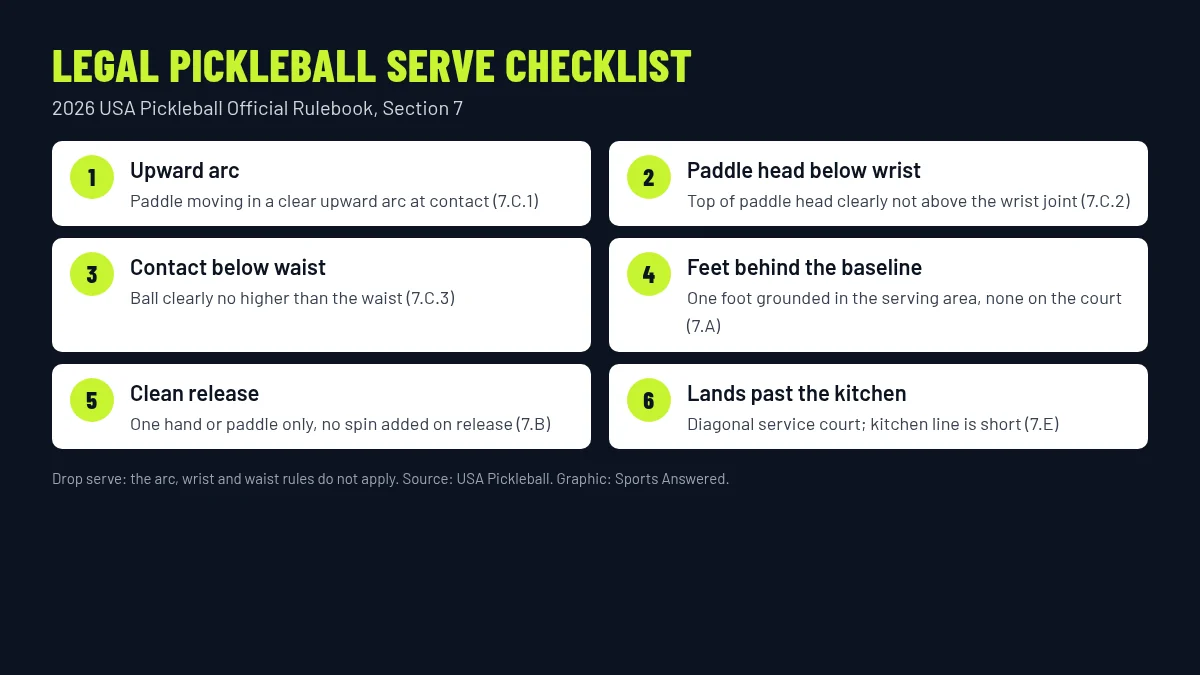
The legal serve checklist
| Check | Volley serve | Drop serve | Rule (2026) |
|---|---|---|---|
| Paddle moving in a clear upward arc at contact | Required | Not required | 7.C.1 |
| Highest point of paddle head not above the wrist joint | Required | Not required | 7.C.2 |
| Ball no higher than the waist at contact | Required | Not required | 7.C.3 |
| Release from natural height, not thrown or pushed | n/a | Required | 7.D.1, 7.D.2 |
| Release with one hand only or the paddle only | Required | Required | 7.B.1 |
| No spin or manipulation added on release | Required | Required | 7.B.2 |
| Release visible to the receiver | Required | Required | 7.B.3 |
| At least one foot on the ground in the serving area | Required | Required | 7.A.1 |
| No foot touching the court (including the baseline) | Required | Required | 7.A.2 |
| No foot outside the serving area (sideline or centerline extended) | Required | Required | 7.A.3 |
| Lands past the kitchen in the diagonal service court | Required | Required | 7.E |
| Served within 10 seconds of the score call | Required | Required | 6.D |
All rule numbers are from the 2026 USA Pickleball Official Rulebook. If you are reading an older guide, the serve rules used to sit in Section 4 (the volley serve was Rule 4.A.7 in 2025); the 2026 Change Document shows the new numbering.
The volley serve: three motion rules
Upward arc. The paddle must be moving in a clear upward arc when it hits the ball (7.C.1). Until 2025 the rule said the server's arm had to move upward; the 2026 rule is about the paddle and adds the word "clearly," which USA Pickleball says makes the rule stronger and more enforceable. Its change document lists this under the heading "Flat Serve" No Upward Arc.
Paddle head below the wrist. The highest point of the paddle head must clearly not be above the highest part of your wrist joint at contact (7.C.2).
Ball below the waist. The ball must clearly be no higher than your waist when the paddle touches it (7.C.3).
Notice the word "clearly." A referee calls a fault when the server is clearly in violation, and may call a replay when it is questionable whether the arc, paddle height or ball height was legal (Rules 20.E.1.a to c and 20.E.2.f to h). Replays must be called before the return of serve.
The drop serve: fewer motion rules
A drop serve is made by dropping the ball and hitting it after it bounces (7.D). The upward arc, wrist and waist rules do not apply. What does apply:
- Release from a natural, unaided height (7.D.1). The rulebook does not let you raise the release point with a boost.
- Do not propel the ball in any direction before hitting it (7.D.2). No tossing it down or up.
- It can bounce any number of times, anywhere on the playing surface, before you hit it (7.D.3, 7.D.4).
Because none of the three volley-motion rules apply, the drop serve leaves less to get wrong.
Spin: hand no, paddle yes
The 2026 rule (7.B.2) says the server must not manipulate the ball to add spin with any part of the body or the paddle before hitting it, except that the ball may roll off the paddle face by gravity. Spin may be applied when the paddle makes contact. USA Pickleball's Change Document calls this "one of the most misunderstood rules" and spells it out: no spin by the hand on release, but spin added by the paddle at contact is allowed (2026 Change Document).
Where your feet go
The serving area is the space behind the baseline, between the imaginary extensions of the sideline and the centerline (3.A.4.g). When you hit the serve:
- At least one foot must be on the ground in that area (7.A.1). Jump serves fail this.
- Neither foot may touch the court (7.A.2). Stepping on the baseline is a fault.
- Neither foot may be outside the area, past the extended sideline or centerline (7.A.3).
Where the serve has to land
The serve goes diagonally and must clear the non-volley zone, with or without touching the net, and land in the correct service court (7.E). A serve that lands in the kitchen is a fault, and per USA Pickleball's rules summary a serve touching the kitchen line is short. We cover the details in what happens when a pickleball serve hits the net.
Who can call an illegal serve?
In a refereed match, the referee calls service faults and replays (Rule 20.E). In non-officiated tournament play, the rulebook says players administer their own matches, and all rules apply except those involving a referee or line judge, with the changes listed in Section 24. The receiver can call for a replay if they could not see the release or think spin was added on the release, but only before returning the serve (7.B.2.a, 7.B.3.a).
Quick questions
- Can I put spin on my pickleball serve?
Yes, with the paddle. The 2026 rulebook bans adding spin or manipulating the ball with your hand or paddle during the release, but spin applied when the paddle contacts the ball is legal.
- Does the drop serve have to follow the waist and wrist rules?
No. The upward arc, paddle-below-wrist and below-waist rules are in the volley serve section. A drop serve must be released from a natural height without being thrown or pushed, and it can bounce any number of times, anywhere.
- Can my foot touch the baseline when I serve?
No. Neither foot may touch the court, which includes the baseline, when the serve is hit, and at least one foot must be on the ground in the correct serving area behind the baseline.
- How long do I have to serve?
Ten seconds after the score is called. Serving late is a fault under Rule 6.D.
- Can I serve backhand?
Yes. The rulebook allows forehand or backhand motions for both volley and drop serves.
Rulebook sources
- 2026 Official Rulebook (Section 7 Serving; Rule 20.E service faults and replays), USA Pickleballusapickleball.org
- 2026 Rulebook Change Document, USA Pickleballusapickleball.org
- Pickleball Rules Summary, USA Pickleballusapickleball.org
Rule statements were checked against these sources on October 18, 2026. See a mistake? Read our corrections policy or email contact@sportsanswered.com.
Who answered
Sports Answered Editorial Team. Researched against the official rules, written and fact-checked by our editors. How we answer
Expert review
Pending. A certified coach or official will review this ruling; their name will appear here only after they approve it.