Is the Line In or Out in Tennis? In, If Any Part of the Ball Touches It
The rulingIn, any contact with the line is good
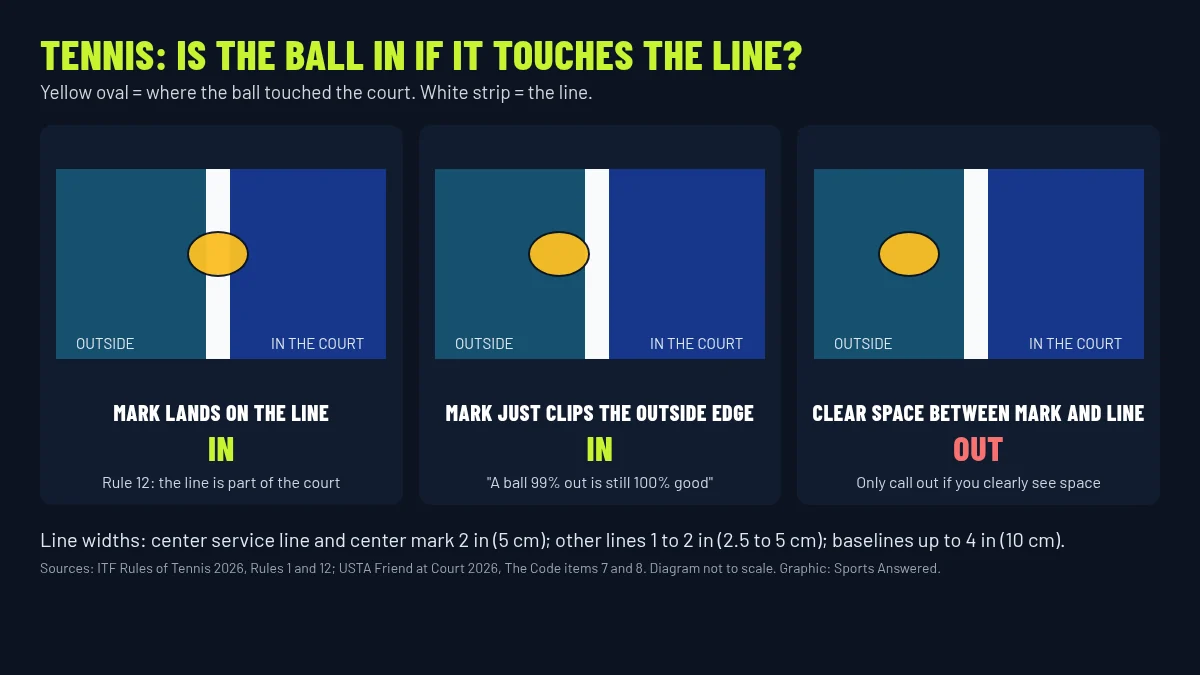
The line is in. If any part of the ball touches any part of a line, the ball is good. ITF Rule 12 says: "If a ball touches a line, it is regarded as touching the court bounded by that line" (ITF 2026 Rules of Tennis).
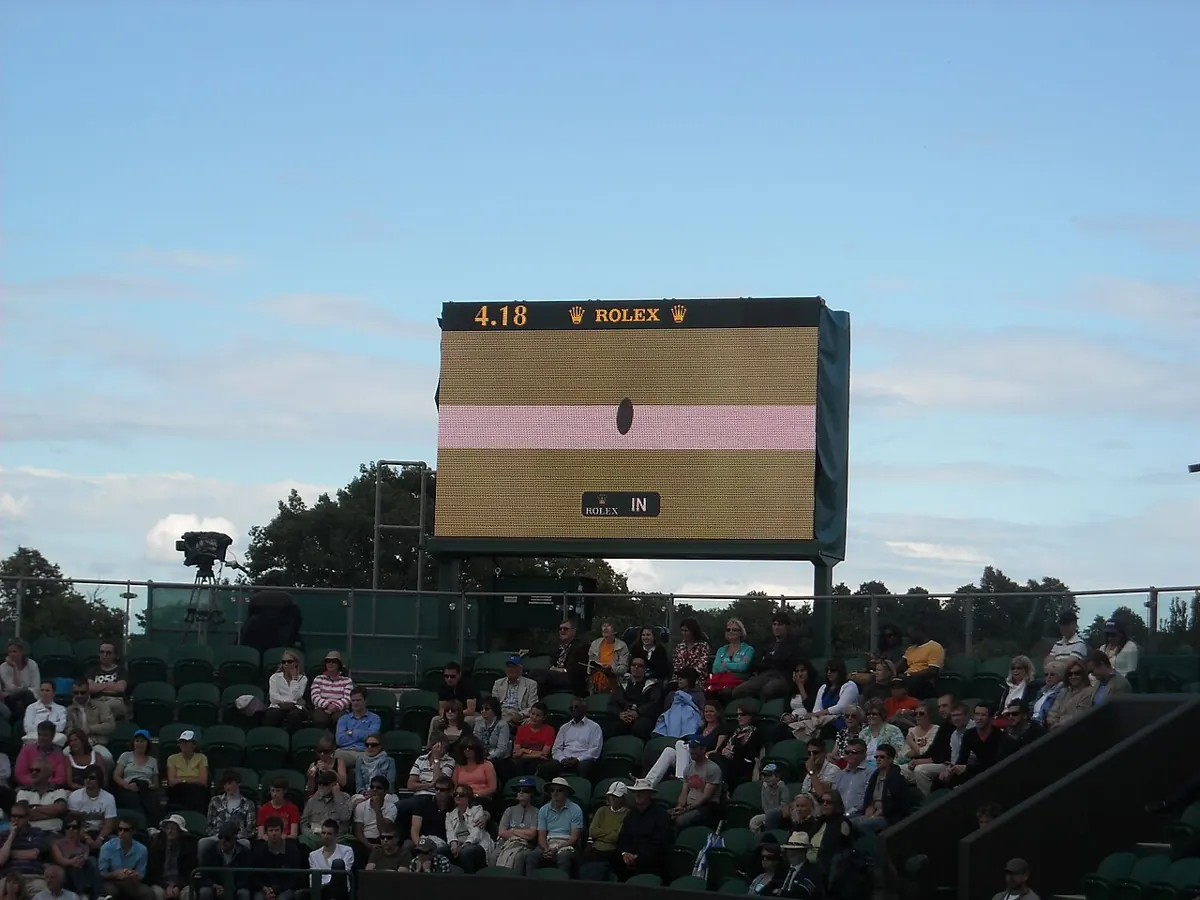
The USTA's Code for unofficiated matches puts it more bluntly: "A ball 99% out is still 100% good." You may only call a ball out if you clearly see space between where it hit and the line (USTA 2026 Friend at Court, Code item 7).
Which lines count
| Line | Singles | Doubles |
|---|---|---|
| Baseline | In | In |
| Inner (singles) sideline | In | In, but the alley beyond it is also in |
| Outer (doubles) sideline | Ball in the alley is out | In |
| Service line, on the serve | In | In |
| Center service line, on the serve | In | In |
| Beyond the service line, on the serve | Fault | Fault |
A singles court is 27 feet (8.23 m) wide and a doubles court is 36 feet (10.97 m) wide, both 78 feet (23.77 m) long (ITF Rule 1). In singles, the doubles alleys are outside the court, so a ball landing in them is out. On the serve, the service court is bounded by the service line, the center service line and the sideline, and a serve touching any of them is good.
Lines are part of the court, and they are not all the same width. Rule 1 sets the center service line and center mark at 2 inches (5 cm), the other lines at 1 to 2 inches (2.5 to 5 cm), and allows the baselines up to 4 inches (10 cm).
Who calls the lines when there is no umpire
Most club, school and league matches have no line judges. The USTA Code sets the rules for calls:
- You call the balls on your own side of the net (item 5), and your opponent gets the benefit of any doubt (item 6).
- A ball you cannot call out with certainty is good, and you cannot claim a let because you did not see it (item 8).
- If you ask your opponent and neither of you has an opinion, the ball is good (item 11).
- If you call a ball out and then realize it was good, the point goes to your opponent and is not replayed (item 12).
- If doubles partners disagree, the ball is good (item 14).
- Out calls must be audible or visible (item 15) and prompt (item 17). Spectators never make calls (item 16).
On serves in doubles, the receiver's partner should call the service line, and the receiver should call the sideline and the center service line (item 25). The serving team does not call first serves out, with one exception: if the receiver plays a first service that is a fault and does not put the return in play, the server or partner may call it (item 26). The serving team must call out any second serve it clearly sees out.
Clay courts: reading the ball mark
Clay shows where the ball landed, so the mark decides close calls. Under the Code, if any part of the ball mark touches a line, the ball must be called good (item 21). If only part of the mark can be seen, the missing part is on the line.
In officiated matches, the ITF Ball Mark Inspection Procedures say inspections can only be made on clay courts. The original call or overrule stands if the umpires cannot find the mark or it is unreadable, and a player who erases the mark before the final ruling concedes the call.
Electronic line calling and challenges
At events using an Electronic Review System, a player can only ask for a review on a point-ending shot or by stopping play. Under the ITF Electronic Review Procedures, each player or team gets three unsuccessful appeals per set, plus one more in the tie-break, and unlimited successful ones. If the system cannot make a decision, the original call stands.
Many tour events now skip challenges altogether. The ATP announced in April 2023 that electronic line calling Live would be used at all ATP Tour events from 2025, with the system making the out calls on all court lines, a job traditionally done by line judges (ATP Tour). In the US, the USTA also allows electronic line calling in sanctioned play.
The line is not in for your feet
Feet work the opposite way. During the service motion, touching the baseline with either foot is a foot fault (ITF Rule 18). Read the full rule in the tennis foot fault rule explained.
If you also play pickleball, the line rules are close but not identical. A pickleball serve on the kitchen line is out, as explained in how pickleball rules differ from tennis. To keep score while you settle line disputes, use our tennis score keeper.
Quick questions
- Is a ball that touches the outside edge of the line in?
Yes. ITF Rule 12 treats a ball touching a line as touching the court that line bounds. The USTA Code says a ball 99% out is still 100% good.
- Are the doubles alleys in or out in singles?
Out. A singles court is 27 feet wide and the outer lines only count in doubles, which is played on a 36-foot-wide court (ITF Rule 1). In singles, the inner sideline is the line that counts.
- Is the service line in on a serve?
Yes. A serve that touches the service line, center service line or sideline of the correct service court is good. If it lands beyond the service line, it is a fault.
- Can you call a ball out if you are not sure?
No. Under the USTA Code, you may only call a ball out if you clearly see space between where it landed and the line. A ball you cannot call out with certainty is good, and you cannot ask for a let because you did not see it.
- Can your foot touch the line on a serve?
No. The line rule works the other way for feet. Touching the baseline with either foot during the service motion is a foot fault (ITF Rule 18).
Rulebook sources
- ITF 2026 Rules of Tennis (Rules 1, 12, 18; Ball Mark Inspection and Electronic Review Procedures), International Tennis Federationitftennis.com
- USTA 2026 Friend at Court, The Code (items 5 to 26), USTAusta.com
- ATP to introduce electronic line calling from 2025, ATP Tour (April 28, 2023)atptour.com
Rule statements were checked against these sources on October 29, 2026. See a mistake? Read our corrections policy or email contact@sportsanswered.com.
Who answered
Sports Answered Editorial Team. Researched against the official rules, written and fact-checked by our editors. How we answer
Expert review
Reviewed by Kelly Simons on October 29, 2026.