Tennis Tiebreak Rules: Serving Order, Switching Ends and the 10-Point Tiebreak
The rulingFirst to 7, win by 2
In a tiebreak set, when the score reaches 6 games all, the players play a tiebreak game. Points are counted 0, 1, 2, 3 and so on, and the first player or team to 7 points with a 2-point lead wins the tiebreak and the set, 7-6. The player due to serve serves the first point; after that, the serve switches every two points, and players change ends after every six points (ITF Rules of Tennis 2026, Rules 5, 6 and 10).
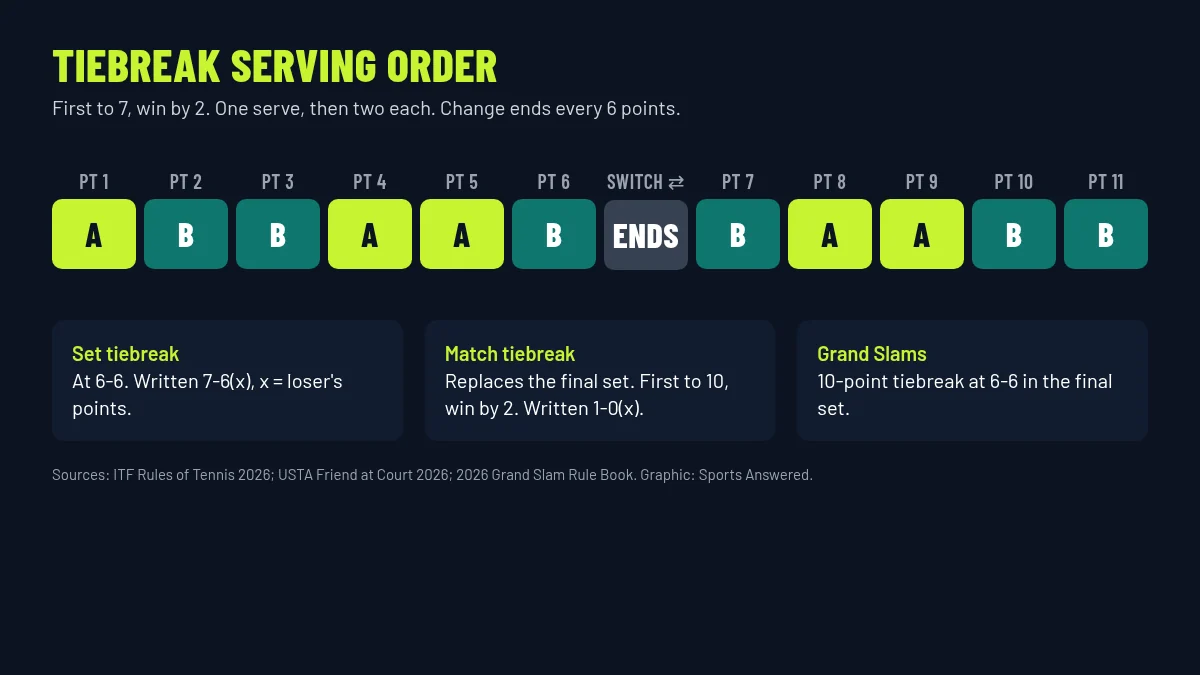
Serving order, point by point
| Point | Who serves | Side |
|---|---|---|
| 1 | Player A (whose turn it was) | Right (deuce) |
| 2 | Player B | Left (ad) |
| 3 | Player B | Right |
| 4 | Player A | Left |
| 5 | Player A | Right |
| 6 | Player B | Left |
| Change ends after point 6 | ||
| 7 | Player B | Right |
| 8, 9 | Player A | Left, then right |
| 10, 11 | Player B | Left, then right |
The pattern comes from Rule 5b: the next server serves one point, the opponent serves the next two, and then each player serves two points in a row until the end. Rule 17 adds that tiebreak serves alternate halves of the court, starting from the right (ITF). A quick memory aid: the sum of points played tells you when to switch ends (every 6), and every odd-numbered total is when the serve changes hands.
How the tiebreak is won
- First to 7 points, with a margin of 2. At 6-6 you keep going until someone leads by 2, so 12-10 or 15-13 is possible (USTA).
- The winner takes the set 7-6.
- The player who served first in the tiebreak receives in the first game of the next set (ITF Rule 5b).
- Because 7-6 is an odd total, players change ends before the next set starts (USTA).
Doubles tiebreak rules
The doubles tiebreak follows the same pattern, with the rotation of servers continuing in the same order as in the set. The ITF says the two points after the first are served by "the player of the opposing team due to serve next" (ITF Rule 5b).
Example, if A and B play C and D, and A is due to serve:
| Points | Server |
|---|---|
| 1 | A |
| 2, 3 | C (or D, whoever was next in that team's order) |
| 4, 5 | B |
| 6, 7 | D |
| 8, 9 | A |
Receiving order also carries over: under ITF Rule 15, the receiving order chosen at the start of a set continues through that set.
Switching ends
Players change ends after every six points and at the end of the tiebreak, without a rest, according to USTA Comment 5.3 in Friend at Court 2026. Some events use the Coman Tiebreak Procedure, which is identical except that ends change after the first point, then every four points, and at the end. A tournament has to announce that it is using Coman before play starts.
The 10-point tiebreaks
There are two kinds of 10-point tiebreak, and they are easy to mix up. Both are first to 10 points, win by 2 (ITF Appendix VI).
| Match tiebreak | Final-set tiebreak | |
|---|---|---|
| When it is played | At one set all (or two sets all in best of 5), instead of a final set | At 6 games all in the final set |
| Replaces | The whole deciding set | Only the rest of the final set |
| Who uses it | Any event that announces it in advance | Grand Slams (2026 rule book) |
| How it is written | 1-0(x) or the tiebreak score in [brackets] | 7-6(x) |
| Set break before it | 120 seconds | Normal changeover |
For the match tiebreak, the ITF says the original serving order continues, doubles teams may change who serves and receives first, there is a 120-second break before it, and balls are not changed before it even if a change is due.
The 2026 Grand Slam Rule Book states that a 10-point tiebreak will be played in the final set at all four majors. The USTA notes that the four Grand Slams adopted the 6-6 final-set 10-point tiebreak in 2022, after the Australian Open had used it since 2019 (USTA).
Short sets (first to 4 games) can use a 5-point tiebreak with a deciding point at 4-4, if the sanctioning body chooses (ITF Appendix VI). If your league uses no-ad games, our explainer on no-ad scoring in tennis covers how deciding points work.
Writing the score
Friend at Court says a set tiebreak is written 7-6(x) or 6-7(x), where x is the points won by the loser of the tiebreak. So 7-6(4) means the tiebreak finished 7-4, and 6-7(14) means 14-16. A match tiebreak played instead of a final set is written 1-0(x), or with the tiebreak score in brackets (Friend at Court 2026).
Quick questions
- Who serves first in a tennis tiebreak?
The player whose turn it is to serve serves the first point, from the right (deuce) side. The opponent serves the next two points, and then the serve alternates every two points.
- How many points is a tiebreak?
A standard set tiebreak is first to 7 points, win by 2. A match tiebreak or final-set tiebreak is first to 10, win by 2. Short sets may use a 5-point tiebreak.
- Do you switch sides in a tiebreak?
Yes, after every six points and at the end of the tiebreak, without a rest. Events using the Coman procedure switch after the first point and then every four points.
- How is a tiebreak written in the score?
The set is written 7-6 with the loser's tiebreak points in parentheses, such as 7-6(4). A match tiebreak played instead of a final set is written 1-0(x) or with the tiebreak score in brackets.
- Do Grand Slams play a tiebreak in the final set?
Yes. The 2026 Grand Slam Rule Book says a 10-point tiebreak is played in the final set. USTA explains it starts at 6-6 in the deciding set.
Rulebook sources
- ITF Rules of Tennis 2026 (Rules 5, 6, 10, 14 and Appendix VI), International Tennis Federationitftennis.com
- Friend at Court 2026 (USTA comments and regulations on tiebreaks), USTAusta.com
- Tennis Scoring: Points, Sets and Games, USTAusta.com
- 2026 Official Grand Slam Rule Book (Section L, Number of Sets, Tie-break), Grand Slam Tennis / ITFitftennis.com
Rule statements were checked against these sources on October 18, 2026. See a mistake? Read our corrections policy or email contact@sportsanswered.com.
Who answered
Sports Answered Editorial Team. Researched against the official rules, written and fact-checked by our editors. How we answer
Expert review
Pending. A certified coach or official will review this ruling; their name will appear here only after they approve it.