Accidentally Hit Your Golf Ball? The Penalty Depends on Where You Were
The rulingOff the tee or on the green: no penalty. Elsewhere: 1 stroke and replace
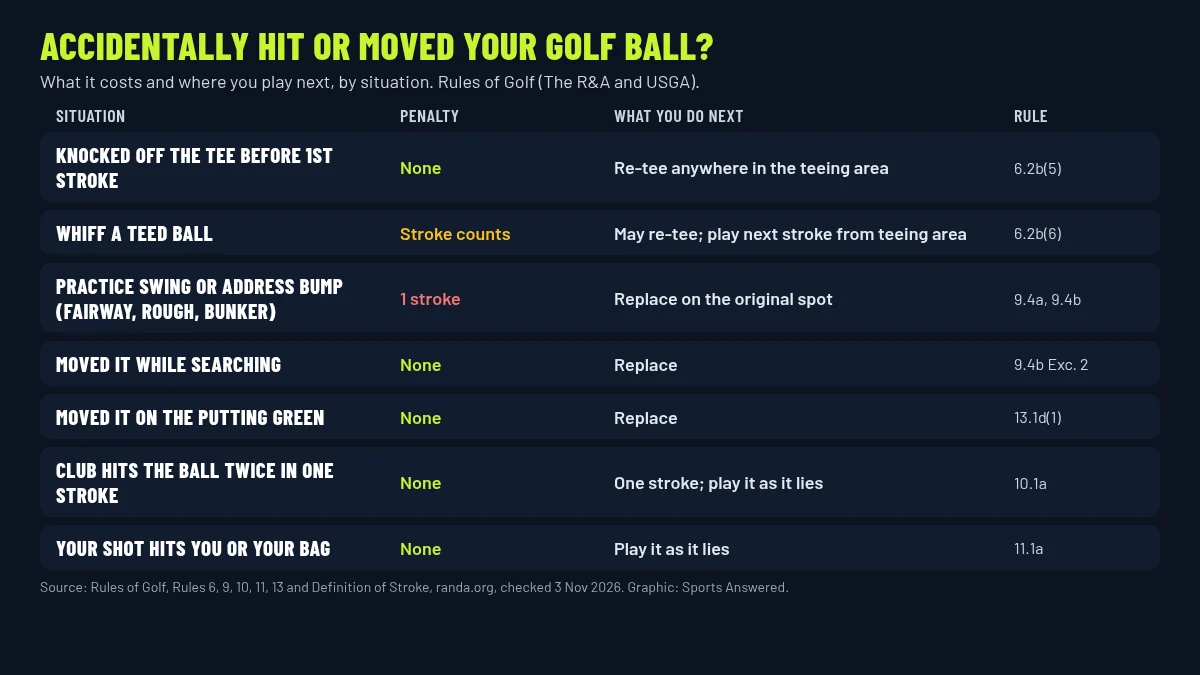
Start by working out where the ball was when it happened, because that decides almost everything. Before your tee shot, nothing you do to the ball counts. On the putting green, accidentally moving it is free. In the fairway, rough or a bunker, causing your ball to move usually costs one penalty stroke and the ball goes back where it was (Rules of Golf, Rule 9).

The second thing to work out is whether you made a stroke at all. Under the Definitions, a stroke is the forward movement of the club made to strike the ball. A practice swing that happens to catch the ball is not a stroke, and neither is a club bumping the ball while you prepare. So these accidents never add a stroke for the swing. When there is a cost, it is a penalty for moving the ball.
On the tee: the ball is not in play yet
Your ball is not in play until you make a stroke at it from the teeing area. If it falls off the tee, or you knock it off with a waggle or a practice swing before your first stroke, Rule 6.2b(5) lets you tee it again anywhere in the teeing area with no penalty (Rule 6).
There is one trap. If you make a stroke at the ball while it is falling, or after it has fallen, that stroke counts and the ball is in play.
A full whiff is different from a practice swing because you were trying to hit it, so the miss is a stroke. Rule 6.2b(6) still gives you some relief: if your ball in play is in the teeing area after the stroke, you may lift or move it without penalty and play from anywhere in the teeing area, including off a tee. Your next swing is your second stroke.
In the fairway, rough or a bunker: one stroke and replace
This is the case most people mean, and it has the strictest outcome. If it is known or virtually certain that you, or your caddie, caused your ball at rest to move, Rule 9.4b gives you one penalty stroke. Rule 9.4a then says the ball must go back on its original spot, estimated if you do not know it exactly.
That covers a practice swing that clips the ball, a club grounded behind it that rolls it a few inches, and a foot that nudges it as you take your stance. In each case you have not made a stroke, so you count the penalty only. Replace the ball and play your next shot as normal.
The "known or virtually certain" test matters at address. Under Rule 9.2a, a ball that only might have moved is treated as not having moved, and you play it as it lies. A ball that oscillated and settled back in the same spot has not moved at all. If wind or water moved it rather than you, Rule 9.3 says there is no penalty and you play it from its new spot.
One case goes the other way. If the ball starts to move after you have begun your backswing and you carry on with the stroke, do not replace it. Rule 9.1b says you play it from wherever it ends up, and Rule 9.4b decides whether you caused the movement and owe a stroke.
The free exceptions
Rule 9.4b lists five exceptions where accidentally moving your ball costs nothing. You still put it back where the Rules require.
- Searching for it. Moving the ball by accident while trying to find or identify it is free.
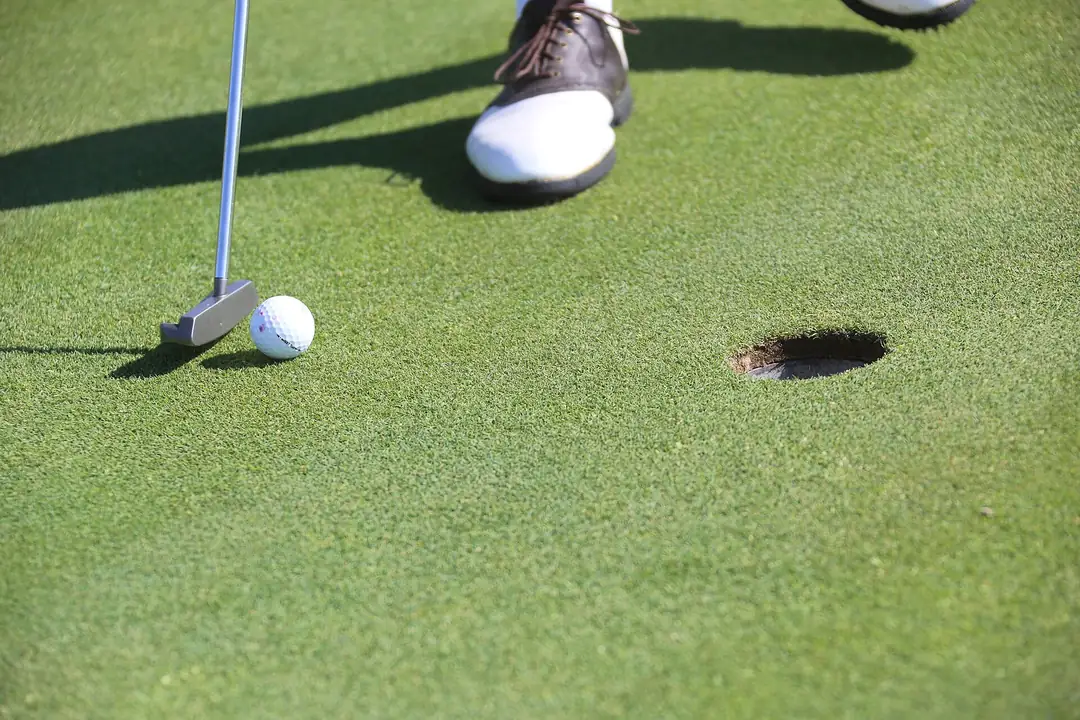
- On the putting green. Rule 13.1d(1) says there is no penalty if you, your opponent or another player accidentally moves your ball or ball-marker on the green. Replace it (Rule 13). That free pass covers a dropped putter or a practice stroke that taps the ball.
- While applying a Rule. Marking, lifting or replacing the ball, removing a movable obstruction, restoring worsened conditions, measuring, or checking where you get relief. Swinging a club to see if a condition interferes is one of the listed examples.
- Ball resting against you. If your ball comes to rest against you or your equipment after a stroke or a drop, moving it as you step away or lift your bag is free.
- Allowed by a Rule. Lifting the ball under a Rule that lets you lift and replace, or take relief, is not a penalty.
When the club hits the ball twice
A real stroke that makes contact twice, such as a chip that catches the ball again on the follow-through, counts as one stroke with no penalty under Rule 10.1a (Rule 10). Play the ball from where it stops.
When your shot hits you
If your ball in motion accidentally hits you, your equipment, another person or an outside influence, there is no penalty for anyone, and you play it as it lies (Rule 11). The exception is stroke play on the putting green: if your putt hits another ball at rest on the green, and both balls were on the green before the stroke, you get the general penalty of two strokes. For more on that case, see what happens when your putt hits another ball on the green.
If you forgot to put it back
Players sometimes take the penalty but then play the ball from where it rolled to. That is playing from a wrong place. The Rule 9.4 note says you then get only the general penalty under Rule 14.7a, which is two strokes in stroke play or loss of the hole in match play. The one-stroke penalty for moving the ball does not stack on top.
Hitting someone else's ball by accident while it is in play is a separate issue. If you actually play it, it is a wrong ball, and our guide to hitting the wrong ball in golf covers the penalty.
A quick way to call it on the course
- Did you make a real stroke, meaning a swing meant to hit the ball? If yes, it counts and you play on (or re-tee if you are still in the teeing area).
- If no, was the ball in play yet? Before the first stroke from the tee, re-tee for free.
- If yes, are you on the green, searching or applying a Rule? Replace it for free.
- Anywhere else: add one stroke and replace the ball.
If the accident happens while you are hunting for the ball in the rough, step 3 applies, and our guide to the lost ball rule covers how long that search can last.
Quick questions
- My practice swing clipped the ball in the fairway. Does that count as a shot?
No. A practice swing that accidentally strikes the ball is not a stroke under the Definitions, so nothing is added for the swing itself. But you caused your ball in play to move, so you add one penalty stroke and put the ball back on its original spot.
- I swung at my tee shot and missed completely. Can I tee it up again?
The miss counts as a stroke, because you made the swing to hit the ball. Your ball is now in play, but since it is still in the teeing area you may lift it, re-tee it if you like, and play your second shot from anywhere in the teeing area without a penalty.
- The ball wobbled at address but I'm not sure it actually moved. What now?
If it is not known or virtually certain that the ball moved, it is treated as not having moved. You play it as it lies and there is no penalty.
- I forgot to put the ball back and hit it from where it ended up. Is that two penalties?
No. If you were required to replace a ball moved under Rule 9.4 and played it from the wrong place instead, you get only the general penalty: two strokes in stroke play or loss of the hole in match play.
Rulebook sources
- Rules of Golf, Rule 9 (Ball Played as It Lies; Ball at Rest Lifted or Moved), The R&A and USGAranda.org
- Rules of Golf, Definitions (Stroke; Known or Virtually Certain), The R&A and USGAranda.org
- Rules of Golf, Rule 6 (Playing a Hole), The R&A and USGAranda.org
- Rules of Golf, Rule 10 (Preparing for and Making a Stroke), The R&A and USGAranda.org
- Rules of Golf, Rule 11 (Ball in Motion Accidentally Hits Person, Animal or Object), The R&A and USGAranda.org
- Rules of Golf, Rule 13 (Putting Greens), The R&A and USGAranda.org
Rule statements were checked against these sources on November 3, 2026. See a mistake? Read our corrections policy or email contact@sportsanswered.com.
Who answered
Sports Answered Editorial Team. Researched against the official rules, written and fact-checked by our editors. How we answer
Expert review
Pending. A certified coach or official will review this ruling; their name will appear here only after they approve it.