What Happens If the Ball Hits You in Tennis? Every Case, Including Serves
The rulingYou lose the point (racket excepted)
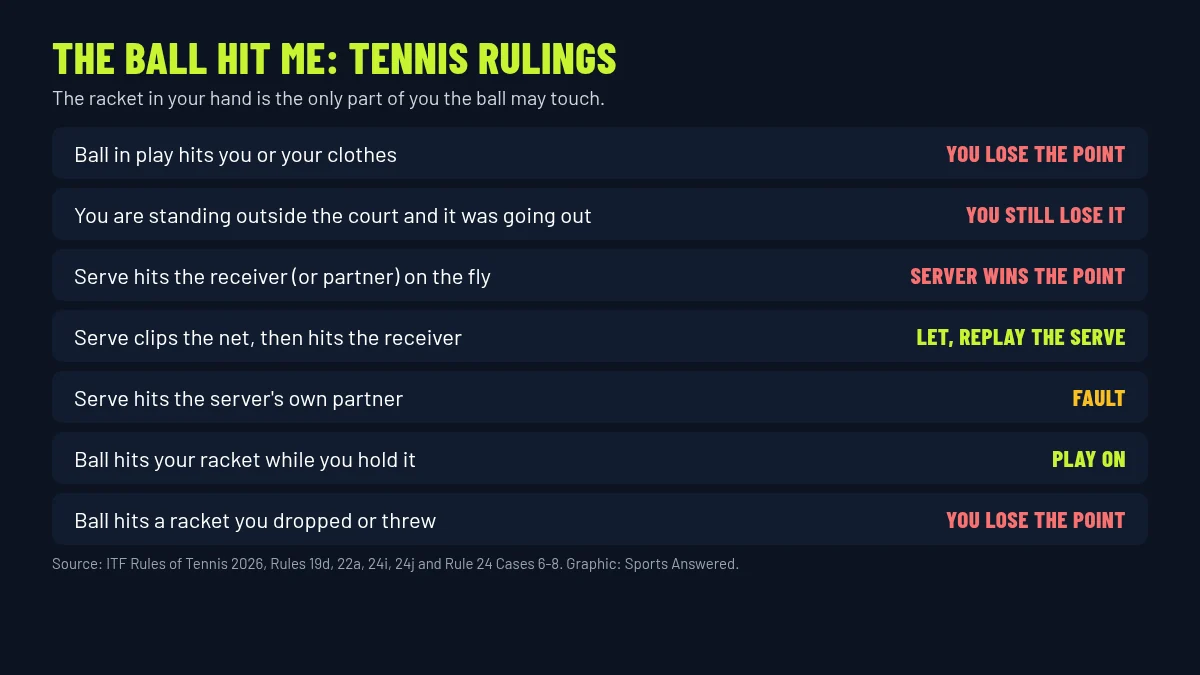
If a ball in play hits you, your clothes or anything you are carrying other than your racket, you lose the point. It does not matter that you were standing outside the court or that the ball was clearly going out. The serve has its own cases: a serve that hits the receiver before bouncing wins the point for the server, a serve that clips the net and then hits the receiver is a let, and a serve that hits the server's own partner is a fault (ITF Rules of Tennis 2026, Rules 19d, 22a and 24i, and Rule 24 Cases 7 and 8).
The rule: only the racket is exempt
Rule 24 lists the ways a player loses a point. Item i reads that the point is lost if "the ball in play touches the player or anything that the player is wearing or carrying, except the racket." Item j adds that the point is also lost if the ball touches the racket when the player is not holding it.
So the racket in your hand is the only safe contact. Your shoe, shirt, hat, hair, wristband and the hand holding the racket are not exceptions. If the ball strikes your fingers instead of the strings or frame, that is the ball touching you.
Every situation in one table
| What happened | Ruling | Source |
|---|---|---|
| Ball in play hits your body or clothing | You lose the point | Rule 24i |
| You are standing behind the baseline or wide of the court and the ball hits you on the fly | You lose the point, even if it was going out | Rule 24 Case 8; USTA shoe ruling |
| You catch a ball before it bounces because it was going out | You lose the point | Rule 24 Case 8; The Code, item 43 |
| Serve hits the receiver (or receiver's partner) before it bounces | Server wins the point | Rule 24 Case 7 |
| Serve touches the net, then hits the receiver or partner before the ground | Let: the serve is replayed | Rule 22a |
| Serve hits the server or the server's partner | Service fault | Rule 19d |
| In doubles, the ball grazes your partner | Your team loses the point | Rule 24i; USTA doubles ruling |
| Ball hits your racket while you hold it | Play continues if the return is good | Rule 24i |
| Ball hits a racket you dropped or threw | You lose the point | Rule 24j; Rule 24 Case 6 |
| Ball hits a ball lying in the correct court | Play continues (let if it is unclear which ball was returned) | Rule 25f and Case 2 |
| Ball hits a bird flying over the court | Point is replayed | Rule 26 Case 3 |
Why "it was going out" never saves you
This is the argument heard most on club courts. Rule 24 Case 8 covers it directly: a player standing outside the court who hits or catches the ball before it bounces, claiming it was going out, loses the point, unless they hit a good return. The USTA applied the same logic when a ball struck a player's shoe on the fly behind the baseline: the player who hit the shot won the point.
The fix is simple. If a ball is flying at you and it is clearly long, get out of the way and let it land.
When the serve hits someone
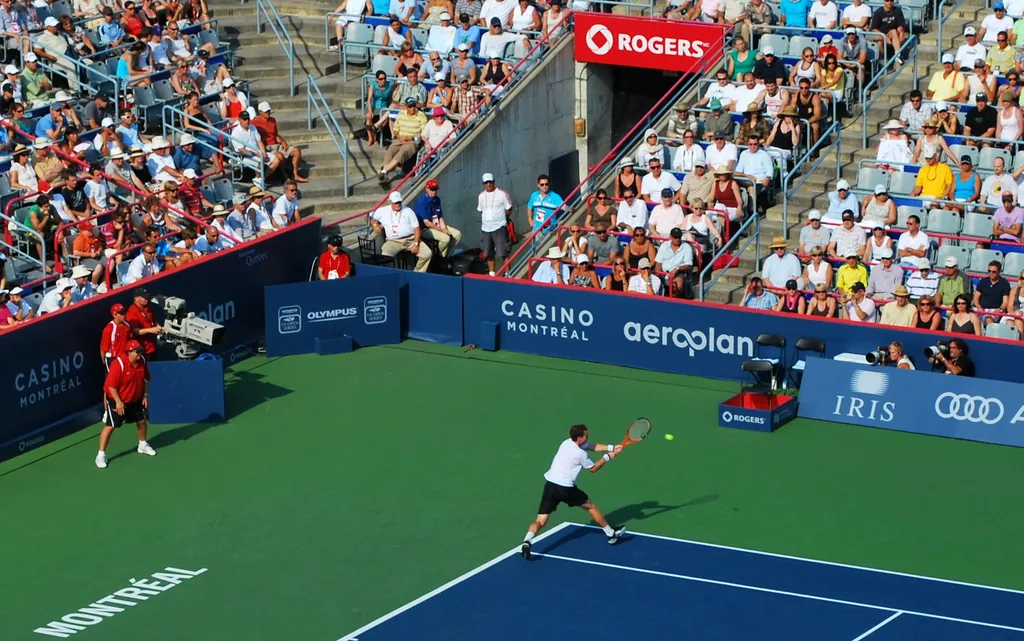
The serve has three different outcomes depending on who it hits and whether it touched the net.
- Serve hits the receiver or the receiver's partner on the fly. The server wins the point (Rule 24 Case 7). Where the receiver was standing does not change this.
- Serve clips the net, then hits the receiver or partner before the ground. That is a service let (Rule 22a). The serve is replayed, and a let on a second serve does not cancel the earlier fault. Some events use the No-Let alternative in Appendix VI, where a serve that touches the net is in play. With no service let available, the Case 7 ruling applies and the server wins the point.
- Serve hits the server's own partner. It is a service fault (Rule 19d). On a first serve, the server serves again; on a second serve, it is a double fault.
Doubles: when the ball hits your partner
Rule 24i applies to each player, so a ball that touches your partner costs your team the point. The USTA gives the same answer for a ball that grazed a doubles partner's head: the team loses the point. Rule 24l also says the team loses the point if both partners touch the ball when returning it.
Who makes the call without an umpire?
In unofficiated matches under the USTA's Code, the player the ball touched must concede the point. The opponent is not entitled to make this call, and any doubt goes to the opponent (Friend at Court 2026, The Code, item 19). The same item covers touching the net, hitting the ball before it crosses the net and double bounces, so honesty is built into the system for all of these.
If the ball injures you
A ball that hits you still loses you the point. If it injures you, the Code treats accidental and deliberate cases differently. When a player accidentally injures an opponent, the opponent suffers the consequences: the Code's example is a server whose racket accidentally strikes the receiver, and if the receiver cannot continue, the server wins by retirement. If an injury is deliberate and affects the opponent's ability to play, the opponent wins by default, and hitting a ball or throwing a racket in anger counts as deliberate (The Code, item 38).
On a single point, Rule 26 also separates intent: if an opponent deliberately hinders you, you win the point; if the hindrance is unintentional, the point is replayed.
Tennis vs pickleball
| Tennis | Pickleball | |
|---|---|---|
| Ball in play hits a player | Player loses the point | Player's side commits a fault |
| Exception | Racket only | Paddle, and the paddle hand below the wrist while holding the paddle |
| Serve hits the receiver on the fly | Server wins the point | Fault against the receiver |
| Serve hits the server's partner | Service fault | Fault against the server |
Pickleball rows: 2026 USA Pickleball Official Rulebook, Rules 7.E.4, 7.E.5 and 10.C.3.
Related rulings
Touching the net is the other "you lose the point instantly" rule; see what happens if you touch the net in tennis. If you are wondering whether you may volley a ball that has not bounced yet, see whether you can hit the ball before it bounces in tennis.
Quick questions
- If the ball hits me and was clearly going out, who wins the point?
Your opponent. Where you stand and where the ball was heading do not matter. If a ball in play touches you before it bounces, you lose the point (ITF Rule 24i and Rule 24 Case 8).
- What if the ball hits my hand on the racket handle?
Rule 24i makes an exception only for the racket. The hand is not listed, so a ball that strikes your hand rather than the racket counts as touching you. Pickleball is different: its rules exempt the paddle hand below the wrist.
- What happens if the serve hits the receiver before it bounces?
The server wins the point, unless it is a service let. If the serve clipped the net first and then hit the receiver, it is a let and the serve is replayed (Rule 24 Case 7 and Rule 22a).
- Can I call it if the ball hits my opponent?
Not in unofficiated play under the USTA Code. The player the ball touched must concede the point, and the opponent is not entitled to make that call (The Code, item 19).
- Can I catch a ball that is clearly going out?
No. Catching a ball in play before it bounces loses the point no matter where you are standing (The Code, item 43).
Rulebook sources
- ITF Rules of Tennis 2026 (Rules 19, 22, 24, 25 and 26), International Tennis Federationitftennis.com
- Friend at Court 2026 (The Code, items 19, 38 and 43), USTAusta.com
- What's the call? Ball hits an opponent's shoe, USTAusta.com
- What's the call? The ball hit my doubles partner, USTAusta.com
Rule statements were checked against these sources on October 27, 2026. See a mistake? Read our corrections policy or email contact@sportsanswered.com.
Who answered
Sports Answered Editorial Team. Researched against the official rules, written and fact-checked by our editors. How we answer
Expert review
Reviewed by Kelly Simons on October 27, 2026.