Can You Hit the Ball Before It Bounces in Tennis? Yes, Except on the Return of Serve
The rulingYes, except the return of serve
Yes. In tennis you can hit the ball before it bounces, called a volley, on any shot except the return of serve. The serve must bounce in the service box before the receiver hits it; returning it in the air loses the point (ITF Rules of Tennis 2026, Rule 24e). After that, either player can volley any ball at any time, as long as the ball has crossed the net to their side.
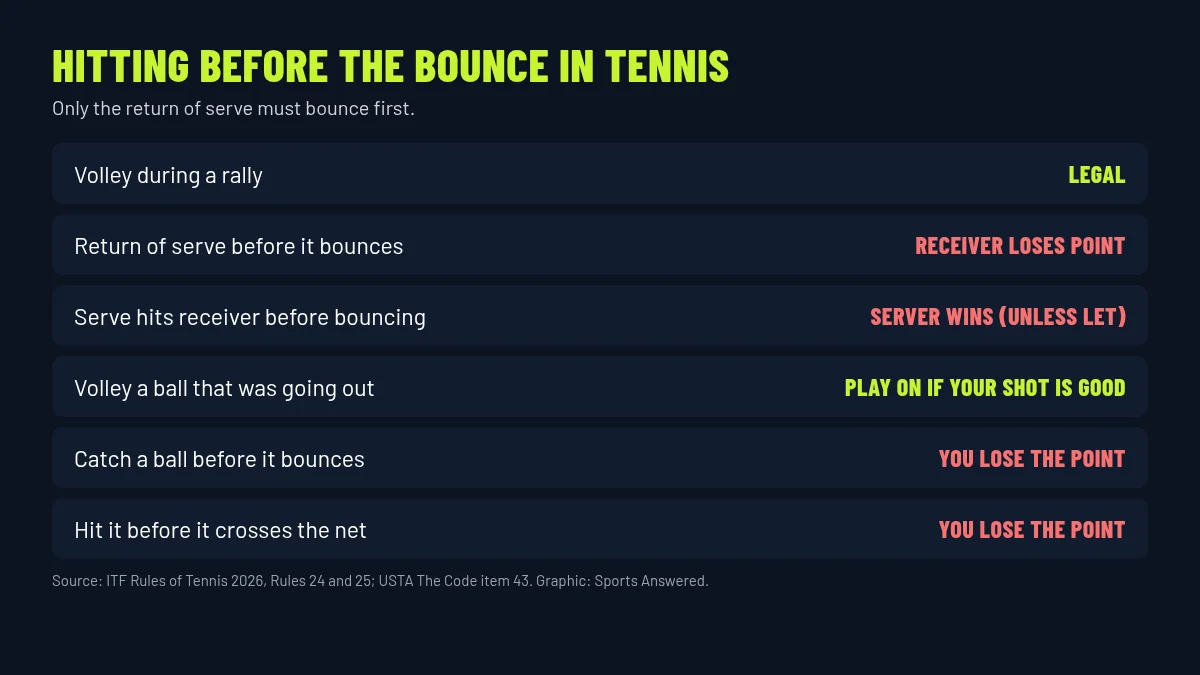
Quick rulings
| Situation | Ruling | ITF rule |
|---|---|---|
| Volley during a rally | Legal | Allowed; only the serve has a bounce requirement |
| Receiver hits the serve before it bounces | Receiver loses the point | 24e |
| Serve hits the receiver (or partner) before bouncing | Server wins the point, unless it is a let | 24, Case 7 |
| You volley a ball that was going out | Ball stays in play; point continues if your shot is good | 24, Case 8 |
| You catch a ball before it bounces because it was going out | You lose the point | 24, Case 8 |
| Ball hits your body or clothing before bouncing, even standing outside the court | You lose the point | 24i |
| You hit the ball before it crosses the net | You lose the point | 24h |
| Ball bounces on your opponent's side, spins back over, and they reach over to hit it | Good return, if they don't touch the net | 25b |
| Ball bounces twice before you hit it | You lose the point | 24b |
All from the ITF Rules of Tennis 2026.
Why the serve has to bounce
Rule 24 lists the ways a player loses a point, and item (e) is simply "the receiver returns the service before it bounces." There is no similar rule for any other shot. So a player at the net can volley the opponent's groundstroke, a lob can be hit as an overhead before it lands, and two players at the net can trade volleys.
The serve is also the only time a ball touching the receiver early goes to the server automatically. In Case 7 under Rule 24, a served ball that hits the receiver or the receiver's partner before touching the ground is the server's point, unless it is a service let.
"It was going out!": catching vs volleying
This is the most common rec-court argument. The ITF's answer in Rule 24, Case 8: a player standing outside the court who hits the ball or catches it before it bounces, and claims the point because the ball was definitely going out, loses the point, unless the shot is a good return, in which case the point continues.
What that means on court:
- Hit it and it lands in: play continues.
- Hit it and it goes out or into the net: you lose the point.
- Catch it: you lose the point.
- Let it hit you: you lose the point (Rule 24i).
The only way to get the point for a ball heading out is to let it bounce out. The Code, USTA's guide for unofficiated matches in Friend at Court 2026, says the same thing in item 43: a player who catches a ball in play before it bounces loses the point regardless of where the player is standing.
Reaching over the net
Rule 24h says you lose the point if you hit the ball before it has passed the net, so you cannot reach over to volley a ball still on your opponent's side. The exception is in Rule 25b: if the ball bounces on your opponent's side and then spins or is blown back over the net, you may reach over and play it into the correct court, provided you do not touch the net or your opponent's court. Touching the net while the ball is in play also loses the point (Rule 24g); our explainer on what happens if you touch the net in tennis covers the timing questions.
How this differs from pickleball
Pickleball adds bounce rules that tennis does not have. Under USA Pickleball's rules summary, the serve and the return of serve must each bounce, and you cannot volley while standing in the non-volley zone (the kitchen). Tennis only requires the return of serve to bounce, and you can volley from anywhere on your side of the net.
Related scoring questions
If a volley ends a long tiebreak point, the serving pattern and change of ends are covered in our guide to tennis tiebreak rules.
Quick questions
- Can you volley a serve in tennis?
No. Under ITF Rule 24e, the receiver loses the point if they return the serve before it bounces.
- What if a serve hits me before it bounces?
The server wins the point, unless it is a let. ITF Rule 24, Case 7, gives that decision even if you are standing outside the court.
- If I volley a ball that was going out, do I lose the point?
Not automatically. Once you hit it, the ball stays in play, and the point continues if your shot is a good return. If you catch it or it hits you, you lose the point.
- Can I hit the ball on my side before it crosses the net?
No. Rule 24h says you lose the point if you hit the ball before it has passed the net. The exception is a ball that bounced on your opponent's side and spun or blew back over, which you may reach over to play.
Rulebook sources
- ITF Rules of Tennis 2026 (Rules 24 and 25), International Tennis Federationitftennis.com
- Friend at Court 2026 (The Code, item 43), USTAusta.com
- Pickleball Rules Summary, USA Pickleballusapickleball.org
Rule statements were checked against these sources on October 18, 2026. See a mistake? Read our corrections policy or email contact@sportsanswered.com.
Who answered
Sports Answered Editorial Team. Researched against the official rules, written and fact-checked by our editors. How we answer
Expert review
Pending. A certified coach or official will review this ruling; their name will appear here only after they approve it.