No-Ad Scoring in Tennis: How the Deciding Point Works
The rulingOne point decides the game at deuce
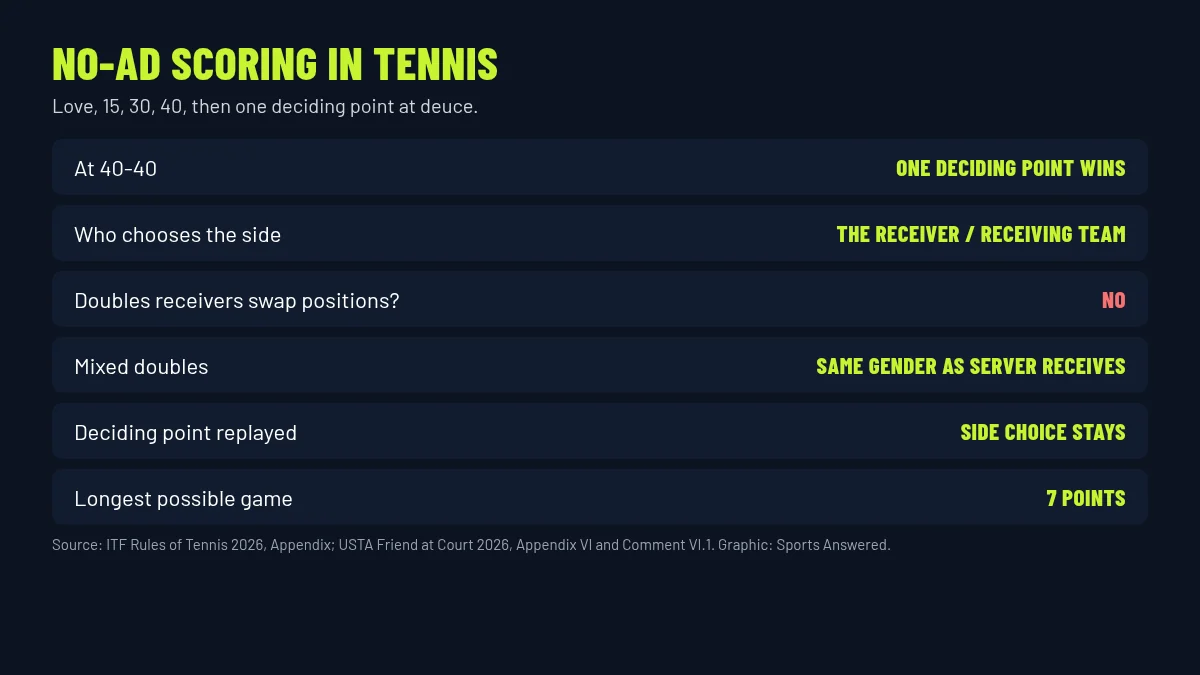
No-ad scoring removes the advantage. Points count love, 15, 30, 40, game as usual, but if the game reaches deuce (40-40), the players play one deciding point, and whoever wins it wins the game. The receiver chooses whether to receive that point on the right or left half of the court (ITF Rules of Tennis 2026, Appendix: "No-Ad" Scoring Method).

Standard vs no-ad scoring
| Standard (advantage) scoring | No-ad scoring | |
|---|---|---|
| Points to win a game | Love, 15, 30, 40, game | Same |
| At 40-40 (deuce) | Advantage to the winner of the next point; you must win 2 points in a row after deuce | One deciding point wins the game |
| Who picks the serving side at deuce | Normal alternation (right, then left) | The receiver chooses right or left |
| Longest possible game | No limit | 7 points |
| Rulebook | ITF Rule 5a | ITF Appendix, "No-Ad" Scoring Method |
Sources: ITF Rules of Tennis 2026, Rule 5 and Appendix.
The deciding point, step by step
- The game reaches 40-40. The score is "deuce."
- The receiver (or the receiving team in doubles) chooses to receive in the right or left half of the court.
- In doubles, the receiving team cannot change positions to receive this point, so choosing the side also chooses which partner receives.
- In mixed doubles, the player of the same gender as the server receives the deciding point, and again the receiving team cannot change positions.
- The point is played. Whoever wins it wins the game.
If the receiver doesn't make a choice and the point is simply played, a USTA Eastern Massachusetts league guide says neither side has grounds for an appeal or a let (USTA Eastern Massachusetts Easy Reference Rule Guide). So make your choice out loud before the server starts.
If the deciding point has to be replayed, for example after a let, the receiver or receiving team may not change the side they chose, according to USTA Comment VI.1 in Friend at Court 2026.
Two sample games
Game 1, standard scoring. Server wins, loses, wins, loses, wins, loses: 40-40, deuce. Server wins: advantage server. Receiver wins: deuce again. Server wins twice: game. That took 10 points, and it could have gone on longer.
Game 2, the same points under no-ad. The first six points reach 40-40, deuce. The receiver picks a side. The server wins the next point: game. That took 7 points, the most any no-ad game can last.
Same players, same first seven points, but the no-ad game ended three points sooner because it never needed a two-point lead.
Why the receiver gets the choice
The ITF Appendix gives the receiver, not the server, the choice of court for the deciding point (ITF). In singles, that lets the receiver choose the side where they return best, such as their forehand side. In doubles, the choice also decides which partner receives, because the receiving team cannot change positions for that point. In mixed doubles, the rule removes the choice of player: the player of the same gender as the server receives, so the team's choice only settles which side that player stands on.
Where you'll see no-ad scoring
No-ad scoring is an approved alternative in the ITF rules, so it's used only when the event chooses it. USTA Regulations say a tournament using no-ad scoring must announce that before play starts, and they list no-ad among the commonly used match formats (Friend at Court 2026). Check your league or tournament format before your first match.

USTA Regulations also let a referee switch to no-ad scoring for any complete round when weather, health or safety concerns require shortening a tournament, though USTA junior regulations may limit this at national junior events. The same regulations say that using no-ad scoring does not change the minimum rest period between matches (Friend at Court 2026).
The ITF Appendix also describes "short" sets, often used with no-ad: the first player or team to win four games wins the set, provided they lead by two, and a tiebreak is played at four games all (ITF).
No-ad often appears alongside other shortened formats, such as short sets or a match tiebreak in place of a third set. Those formats have their own scoring, explained in our guide to tennis tiebreak rules and how a tiebreak is scored.
How much time it saves
Tournament referees plan around match length. Friend at Court's scheduling table gives these averages for a best-of-three-set match without a match tiebreak (Friend at Court 2026, Table 7):
| Conditions | Average match length |
|---|---|
| Indoors | 75 minutes |
| No-ad scoring | 75 minutes |
| Outdoor hard court | 90 minutes |
| Outdoor clay, early rounds | 90 minutes |
| Outdoor clay, later rounds | 105 minutes |
Those are planning averages, not limits. But they show why leagues and busy tournaments like no-ad: it makes outdoor matches closer in length to indoor ones and easier to schedule.
No-ad with numeric scoring
Some players call scores with numbers. Friend at Court describes numeric scoring as "zero," "one," "two" and "three" in place of love, 15, 30 and 40, and notes that the principle of winning by two points holds except when no-ad scoring is used (Friend at Court 2026). Under no-ad, "3-all" is deuce, and the next point decides the game. There is no "4-3."
In its glossary, Friend at Court calls the point played at deuce the "No-Ad Point," and describes the mixed doubles rule the same way as the ITF: the man serves the point to the man, and the woman serves it to the woman. In all other events, the receiver chooses the side.
The "No-Let" combination
Some events combine no-ad with the ITF's "No-Let" alternative, where a serve that touches the net, strap or band and lands in is played rather than replayed. When the sanctioning body chooses, in doubles using short sets with no-ad and no-let, either player on the receiving team may return a serve that clips the net and lands in the correct service box (ITF, Appendix).
Calling the score
The server's score is called first, just as in a standard game. Under no-ad, "40-40" is still called "deuce," but there is no "ad in" or "ad out" afterward. The next point ends the game.
Quick questions
- Who chooses the side on the no-ad deciding point?
The receiver, or in doubles the receiving team. They pick whether the serve comes to the right or left half of the court.
- Can the receiving doubles team switch who receives on the deciding point?
No. The players of the receiving team cannot change positions to receive the deciding point. They only choose which side the serve goes to, which decides which of them receives it.
- Who receives the deciding point in mixed doubles?
The player of the same gender as the server. The receiving team still cannot change positions.
- If the deciding point is replayed, can the receiver change sides?
No. USTA Comment VI.1 says that when a deciding no-ad point is replayed, the receiver or receiving team may not change the choice of court.
Rulebook sources
- ITF Rules of Tennis 2026 (Rule 5 and Appendix: Alternative Procedures and Scoring Methods), International Tennis Federationitftennis.com
- Easy Reference Rule Guide, USTA Eastern Massachusettsusta.com
- Friend at Court 2026 (Appendix VI, USTA Comment VI.1, USTA Regulations), USTAusta.com
Rule statements were checked against these sources on October 22, 2026. See a mistake? Read our corrections policy or email contact@sportsanswered.com.
Who answered
Sports Answered Editorial Team. Researched against the official rules, written and fact-checked by our editors. How we answer
Expert review
Reviewed by Kelly Simons on October 19, 2026.